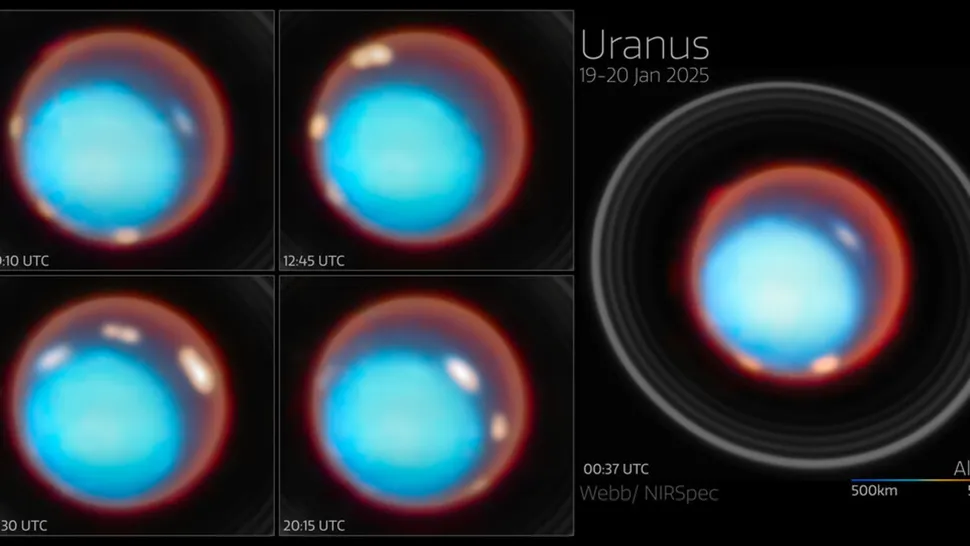
In January 2025, the James Webb Space Telescope watched Uranus spin for 15 hours, capturing bright auroras glowing near the planet’s magnetic poles. (Image courtesy of ESA/Webb, NASA.
Scientists have taken a major step in understanding Uranus. Using the James Webb Space Telescope, researchers have created the most detailed map yet of the planet’s upper atmosphere. The new observations reveal unusual features in Uranus’ magnetic field and striking auroras glowing high above the planet’s clouds.
The space telescope observed Uranus for about 15 hours, nearly the length of a full day on the planet. During that time, researchers studied how energy moves through the upper atmosphere and how the planet’s glowing light displays form.
A Magnetic Field Like No Other
Uranus stands out among the large planets in our solar system. Its magnetic field tilts about 60 degrees away from its geographic poles. This unusual angle changes how charged particles interact with the planet.
On Earth, auroras usually appear near the north and south poles. On Uranus, however, the tilted magnetic field allows auroras to stretch far beyond the polar regions. The new observations show just how far those glowing lights reach.
Researchers focused on Uranus’ magnetosphere — the area of space around the planet that its magnetic field controls. The shape and position of this magnetic field create complex patterns in the atmosphere.
"Uranus's magnetosphere is one of the strangest in the solar system," study lead author Paola Tiranti, a doctoral student at Northumbria University in the U.K., said in a European Space Agency (ESA) statement. "Webb has now shown us how deeply those effects reach into the atmosphere."
Mapping the Upper Atmosphere
The telescope captured detailed information about charged particles high above Uranus’ cloud tops. Scientists measured temperature and density up to 5,000 kilometres above the surface.
The results surprised researchers. The warmest regions did not match the densest ones. Ions reached their highest temperatures between about 4,000 and 5,000 kilometres above the clouds. However, the highest concentration of particles appeared much lower, around 1,000 kilometres above the cloud tops.
Scientists believe the planet’s unusual magnetic field shape explains this difference. The twisting geometry of the field influences how particles move and heat up.
Bright Auroral Bands
The telescope also detected two bright auroral bands near Uranus’ magnetic poles. Between these glowing regions, researchers found areas with fewer charged particles and weaker auroras.
This pattern may occur when magnetic field lines shift from one region to another. Similar transition zones have appeared in studies of Jupiter’s upper atmosphere.
Signs of Cooling
In addition to mapping the atmosphere in three dimensions for the first time, the new observations confirmed that Uranus has cooled over the past few decades. The average temperature of the upper atmosphere measured about 153 degrees Celsius.
This reading appears lower than earlier measurements from other spacecraft and telescopes. Scientists have tracked a steady cooling trend since the early 1990s.
"By revealing Uranus's vertical structure in such detail, Webb is helping us understand the energy balance of the ice giants," Tiranti said. "This is a crucial step towards characterizing giant planets beyond our solar system."
Looking Beyond Our Solar System
Understanding Uranus helps scientists learn more about ice giants in general. Many planets discovered outside our solar system resemble Uranus in size and composition.
By studying how energy flows through Uranus’ atmosphere and how its magnetic field shapes auroras, researchers gain insight into distant worlds as well.
The findings offer a clearer picture of one of the solar system’s most mysterious planets and open the door to future discoveries.