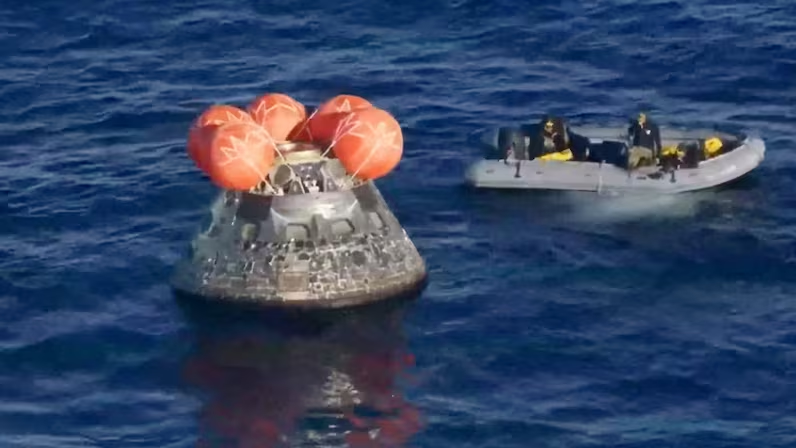
A recovery vessel moves toward the Artemis II crew capsule as it floats in the Pacific Ocean following its landing. NASA
The Artemis II astronauts returned safely to Earth after their spacecraft landed in the Pacific Ocean off the coast of California. The mission came to a close as the Orion capsule touched down on schedule near San Diego after a 10-day journey through space.
The four crew members — Reid Wiseman, Victor Glover, Christina Koch, and Canadian astronaut Jeremy Hansen — completed a trip that took them farther from Earth than any humans have travelled before.
Safe Return After High-Speed Re-entry
The spacecraft re-entered Earth’s atmosphere at speeds close to 40,000 kilometres per hour. Despite the intense heat and pressure, the capsule performed well, and the crew remained safe throughout the descent.
Soon after landing, recovery teams reached the capsule and opened the hatch. One by one, the astronauts stepped out into the fresh air for the first time since their launch.
Crew in Good Health
All four astronauts left the capsule without assistance and walked to the medical area on the recovery ship. Medical teams began routine checks to ensure their health after several days in space.
They later boarded helicopters that carried them to a nearby ship, where they will remain under observation before returning to land.

Astronauts Victor Glover and Christina Koch appeared in high spirits, smiling and celebrating as they sat aboard the recovery vessel following their return. NASA
Commander Reid Wiseman confirmed earlier that every crew member was safe and doing well after the landing.
A Milestone for Canada and Space Exploration
The mission marked a major moment for Canada, as Jeremy Hansen became the first Canadian astronaut to travel to the moon. His journey has drawn attention and pride from across the country.
Leaders and space experts praised the mission, calling it an important step forward in human space exploration.
Preparing for Future Missions
The Artemis II mission has helped space agencies test new systems and prepare for future flights. Engineers will now study how the Orion spacecraft performed during the mission, especially during re-entry.
These findings will guide upcoming missions, including plans to send astronauts to the moon’s surface in the next phase.
A Journey to Remember
The crew spent more than nine days in space, including time without gravity. While some astronauts had previous experience in space, the mission marked a first for Hansen, who will now adjust back to life on Earth.
The successful return highlights the effort of teams on the ground who worked for years to make the mission possible.
With this milestone complete, the path now opens for future lunar missions and deeper space exploration.