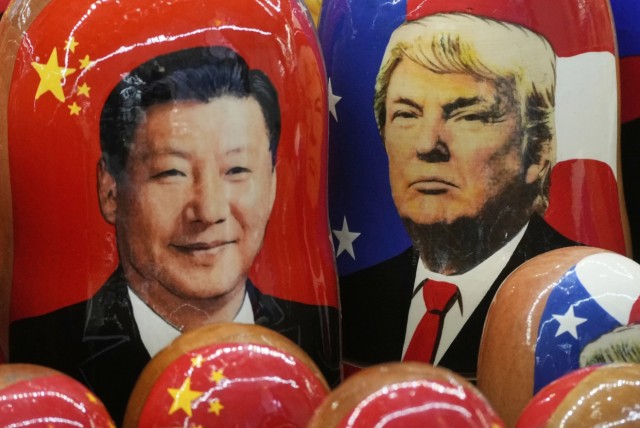
Traditional Russian wooden dolls called metryoshka depicted China’s president Jingping and President Donald Trump at a souvenir shop in St. Petersburg, Russia.
The United States and China have agreed to extend their trade truce for another 90 days. The move temporarily eases tensions between the world’s largest economies and delays a potential escalation in tariffs.
President Donald Trump confirmed the decision on his Truth Social account. He said he had signed an executive order to keep “all other elements of the Agreement” unchanged. Beijing also announced the extension through its official news agency, Xinhua.
The previous deadline was set to expire at 12:01 a.m. Tuesday. Without this extension, U.S. tariffs on Chinese imports could have jumped from 30% to even higher levels. China was ready to retaliate with its own levies on U.S. goods.
A Breathing Space for Negotiations
The 90-day pause gives both sides more time to iron out differences. Business groups are hopeful that this window could pave the way for a meeting between Trump and Chinese President Xi Jinping later this year.
Sean Stein, president of the U.S.-China Business Council, called the extension “critical.” He said U.S. companies need stability to plan for the medium and long term. A deal could help American agriculture and energy exports restart after being hit by China’s retaliatory tariffs.
Tariff Wars and Global Trade Shifts
Since taking office, Trump has reshaped global trade. High tariffs have replaced America’s once-open trade policies. The average U.S. tariff has soared from 2.5% to 18.6%—the highest since 1933, according to Yale University’s Budget Lab.
Other nations, including Japan and the European Union, accepted trade deals with unusually high U.S. tariffs to avoid even harsher measures. However, China pushed back harder. It used its control over rare earth minerals—essential for electric vehicles and jet engines—as leverage.
Recent Concessions from Both Sides
In June, Washington and Beijing reached a partial agreement to ease tensions. The U.S. relaxed export restrictions on chip technology and ethane. China agreed to improve U.S. access to rare earth minerals.
Analysts say these moves show Washington has realized it does not hold the upper hand. Claire Reade, a former U.S. trade official, noted that both sides understand the damage of prolonged conflict.
Avoiding a Full-Blown Trade Meltdown
In May, the two countries stepped back from extreme tariffs—some as high as 145% on Chinese goods and 125% on U.S. products. Those levels had rattled global markets and threatened to halt trade entirely.
Following talks in Geneva, tariffs were reduced to 30% for U.S. imports from China and 10% for Chinese imports from the U.S. The softer approach allowed negotiations to continue without collapsing trade relations.
Limits of Tariff Power
Ali Wyne, an expert on U.S.-China relations, said the Trump administration overestimated its ability to force China into concessions. Beijing, he argued, now believes it can maintain leverage by threatening to cut rare earth exports.
The desire for a trade détente is partly driven by the damage caused by earlier tariff hikes. The U.S. wants to avoid further economic self-harm while keeping talks alive.
Big Disputes Still on the Table
Despite the extension, major issues remain unresolved. Washington accuses Beijing of weak intellectual property protections and unfair subsidies for Chinese industries. These policies, U.S. officials say, contribute to a large trade deficit—$262 billion last year.
Experts believe only smaller deals are likely in the short term. China might agree to buy more American soybeans, curb chemicals used in fentanyl production, and maintain rare-earth supplies.
But Jeff Moon, a former U.S. diplomat, warned that deeper disputes could last for years. “The trade war will continue grinding ahead,” he said.
Outlook for the Next 90 Days
The new extension offers hope for progress, but also highlights the fragility of U.S.-China trade relations. Businesses welcome the pause, yet they remain cautious.
If no significant breakthroughs occur, the world’s two largest economies could return to another tariff showdown—putting global trade and market stability at risk once again.