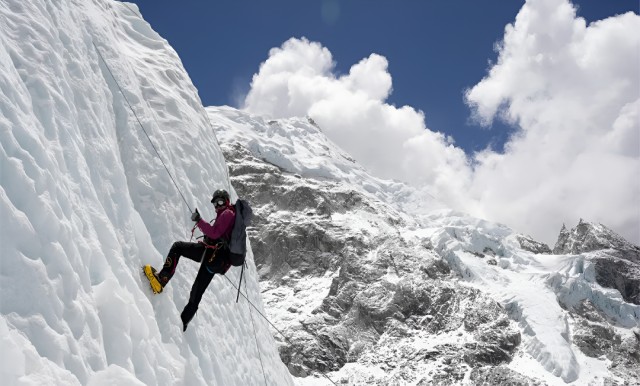
A climber grips the rope during an ice climbing session at Everest base camp, Nepal, on April 15, 2025. Reuters
Nepal has announced a new law aimed at improving safety on Mount Everest by restricting climbing permits to only those climbers who have previously scaled at least one of Nepal’s 7,000-meter peaks. The new rule comes in response to growing concerns about overcrowding on the world’s highest mountain, and it is designed to reduce the risks posed to climbers, particularly in the notorious “Death Zone” where oxygen levels are dangerously low.
Overcrowding on Mount Everest
Mount Everest, standing at 8,849 meters (29,032 feet), attracts climbers from all over the world, with many hoping to reach the summit. However, the popularity of the mountain has led to severe overcrowding, especially in the final stretch near the summit. Climbers often face long queues in the “Death Zone,” an area above 8,000 meters, where the air is thin and the risk of fatal accidents increases.
This overcrowding has been blamed for numerous deaths on the mountain. In 2023 alone, 12 climbers died, and five went missing, despite Nepal issuing 478 permits. The previous year, eight climbers lost their lives while attempting to summit Everest.
New Law to Ensure Safer Climbing
The proposed law will require all climbers to show proof that they have successfully climbed a mountain of at least 7,000 meters in Nepal before applying for an Everest permit. This new requirement aims to ensure that only experienced climbers take on the challenges of Everest.
The law also stipulates that the head of the climbing team, or “sardar,” and the local guide must be Nepali citizens, reinforcing the importance of local expertise in guiding expeditions. The draft bill has been submitted to Nepal's National Assembly, where it is expected to pass, as the ruling alliance holds a majority.
Reactions to the Proposed Law
International expedition organizers have voiced concerns about the new law, suggesting that it should not only include 7,000-meter peaks in Nepal. Lukas Furtenbach, an expedition leader from Austria, argued that other 7,000-meter mountains worldwide, like Aconcagua in Argentina or Denali in the U.S., should be considered for eligibility. He also suggested that mountains close to 7,000 meters, such as Ama Dablam, should be included as preparatory climbs.
Furtenbach also emphasized the need for qualified mountain guides, regardless of nationality. He argued that guides must have internationally recognized qualifications, such as those from the International Federation of Mountain Guides Associations (IFMGA), to ensure safety. Currently, there is a shortage of Nepali guides with such qualifications.
Alternatives to 7,000-Meter Peaks
Garrett Madison, a U.S.-based expedition leader, also pointed out that finding a suitable 7,000-meter peak in Nepal could be challenging. He suggested that climbing peaks as low as 6,500 meters could be a better option for gaining the necessary experience to summit Everest.
Nepal has over 400 mountain peaks open for expeditions, with 74 of them surpassing 7,000 meters. However, not all of these mountains are popular or accessible to climbers, and some are seen as less attractive options for serious mountaineering.
Tashi Lhakpa Sherpa, a veteran mountaineer who has summited Everest eight times, also noted that only a few of Nepal’s 7,000-meter peaks are frequently climbed. He explained that the limited popularity of these mountains could make it harder for climbers to gain the necessary experience to tackle Everest.