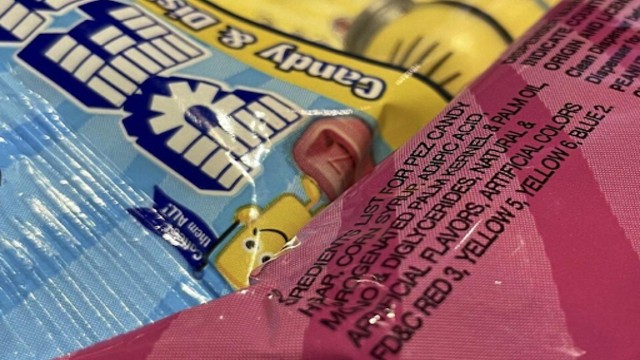
Pez candy, which contains red dye no. 3, is on display at a store in Lafayette, Calif., March 24, 2023. (AP Photo/Haven Daley, File)
In a significant move on Wednesday, U.S. regulators banned the use of the artificial dye Red 3 in food products, nearly 35 years after it was prohibited in cosmetics due to cancer concerns. The ban, which applies to a range of food items, dietary supplements, and oral medicines, was prompted by a 2022 petition filed by health and food safety advocates. The petition urged the Food and Drug Administration (FDA) to revoke the authorization for Red 3, a dye that gives foods like candies, snack cakes, and maraschino cherries their bright red color.
The FDA's decision was made in response to studies showing that the dye, also known as erythrosine or FD&C Red No. 3, caused cancer in lab rats. The action is in line with the Delaney Clause, a law that mandates the removal of any additive found to cause cancer in humans or animals. While the dye was banned in cosmetics and externally applied drugs in 1990 after similar studies, it remained permitted in food and ingested drugs due to the belief that its cancer-causing effects did not apply to humans.
The FDA's deputy commissioner for human foods, Jim Jones, emphasized that the decision was based on legal grounds, stating, "Evidence shows cancer in laboratory male rats exposed to high levels of FD&C Red No. 3. Importantly, the way that FD&C Red No. 3 causes cancer in male rats does not occur in humans." The agency has set a deadline of January 2027 for food manufacturers to eliminate Red 3 from their products, while companies producing ingested drugs have until January 2028 to comply. Imported foods will also be subject to the new U.S. requirements.
Consumer advocates have praised the FDA's decision, calling it long overdue. Dr. Peter Lurie, director of the Center for Science in the Public Interest (CSPI), which led the petition, welcomed the ban as a necessary step to address the double standard that allowed Red 3 in food but banned it in cosmetics. However, it remains uncertain whether food manufacturers will challenge the ban in court, as scientific evidence has not conclusively linked Red 3 to cancer in humans.
The move follows growing concerns about food additives and their potential impact on health, especially for children, who consume more of the dye relative to their body weight. A letter from nearly two dozen members of Congress urged the FDA to act swiftly, emphasizing that no aesthetic benefit could justify the inclusion of a carcinogen in the food supply.
A recent AP-NORC poll revealed that two-thirds of Americans support restrictions on processed foods, with higher levels of support among college-educated adults and those with higher household incomes. Globally, Red 3 is already banned for food use in Europe, Australia, and New Zealand, with some exceptions for specific types of cherries.
In the U.S., California has announced a ban on Red 3 starting in 2027, and other states, including Tennessee, Arkansas, and Indiana, have proposed similar restrictions, particularly for foods served in schools.
The International Association of Color Manufacturers, however, has defended the dye, asserting that it is safe in the amounts typically consumed by humans. The group cites research from the United Nations and the World Health Organization, including a 2018 review that reaffirmed Red 3's safety.
Some food manufacturers have already begun reformulating products to eliminate Red 3, replacing it with natural alternatives like beet juice, carmine (a dye derived from insects), and pigments from fruits and vegetables such as purple sweet potato and red cabbage.