Fredericton City Council meeting highlights parenthood in politics. 👶🏛️
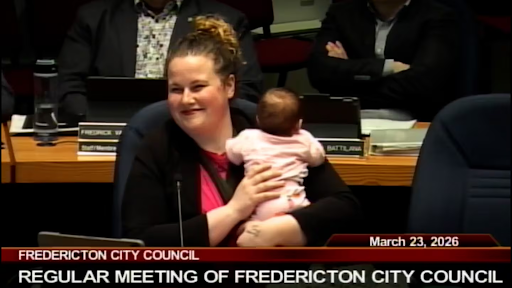
A recent Fredericton city council meeting drew attention for an unexpected yet meaningful presence, as Councillor Cassandra LeBlanc attended with her seven-week-old baby, Josie. The moment reflected a growing conversation around balancing public service with parenthood, while also highlighting the need for more inclusive political spaces.
LeBlanc’s decision to bring her newborn to the meeting marked her first in-person appearance since giving birth. While she had continued participating virtually, returning to the council chamber signaled both a personal and professional milestone.
Breaking Barriers at the Council Table
For LeBlanc, the experience was not without its challenges, as she navigated concerns familiar to many new parents. She admitted to worrying about practical issues, including feeding, diaper changes, and the possibility of disruptions during important discussions.
Despite these anxieties, the meeting unfolded smoothly, with Josie quietly accompanying her mother throughout the proceedings. The moment underscored how workplaces, including political institutions, can adapt to better support working parents.
LeBlanc, who ran for council at just 27, has always intended to balance her career with family life. Her decision to bring her child into the council environment reflects a broader belief that such choices should not be mutually exclusive.
Support and Changing Attitudes in Leadership
LeBlanc credited her colleagues and Fredericton’s mayor, Kate Rogers, for fostering a supportive environment. Rogers, the city’s first female mayor, has been vocal about the need to make political spaces more welcoming for women.
She acknowledged that traditional structures often discouraged women from participating, particularly those balancing family responsibilities. According to Rogers, creating an inclusive environment requires intentional change, ensuring that women feel both represented and supported at decision-making tables.
This evolving mindset is gradually reshaping expectations around who belongs in leadership roles and how those roles can be fulfilled.
A Broader Push for Inclusion in Politics
LeBlanc’s experience reflects a wider shift across Canada, where more women are challenging long-standing norms in political institutions. Historically, such spaces have been dominated by men, often making it difficult for young mothers to envision themselves in these roles.
Past efforts have already highlighted these gaps. In New Brunswick, MLA Megan Mitton previously advocated for basic facilities like change tables in legislative buildings, emphasizing the need for practical support systems.
These changes, while incremental, signal a growing recognition that structural barriers must be addressed to encourage greater participation from diverse groups.
Inspiring the Next Generation
Beyond the immediate moment, LeBlanc hopes her actions will have a lasting impact, both for her daughter and for others watching. She expressed a desire for Josie to grow up in a world where women, including young mothers, are a common presence in leadership positions.
Her story serves as a reminder that representation matters, not only in policy decisions but also in everyday visibility within public institutions. By bringing her child to work, LeBlanc has contributed to a broader narrative about redefining professional norms.
A Step Toward More Inclusive Governance
As conversations around work-life balance continue to evolve, moments like these highlight the importance of flexibility and inclusivity in modern workplaces. For political institutions, in particular, adapting to these realities can help ensure that leadership reflects the communities it serves.
LeBlanc’s decision may seem simple, but it carries deeper implications for the future of governance. By normalizing the presence of parents in professional spaces, it opens the door for more individuals to consider public service without sacrificing personal aspirations.
In the end, the Fredericton city council meeting was not just about policy discussions, but also about progress, representation, and the changing face of leadership.