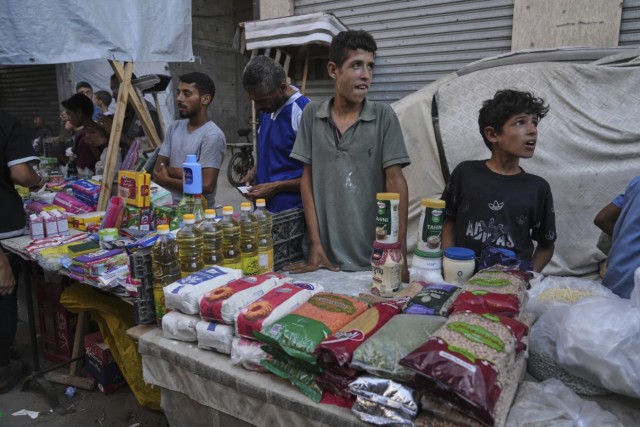
Palestinian Vendors display goods for sale at a street market in Gaza City, Wednesday, July 23, 2025.
In Gaza, a humanitarian disaster is unfolding. As Israel’s ongoing offensive dismantles law and order, food aid is no longer reaching the people who need it most. Instead, gangs and opportunistic merchants are hoarding life-saving supplies and reselling them at inflated prices.
Desperation grows as families face a deadly combination of hunger, insecurity, and chaos.
Aid Meant for Free, Now Sold at Unthinkable Prices
Since the collapse of internal security in Gaza, even the most basic staples have become luxuries. A kilogram of flour now sells for up to $60. Lentils fetch as much as $35. Most families simply cannot afford these prices, especially after nearly two years of war have drained savings.
While some price relief has come following international pressure on Israel to allow more aid, most residents are still waiting to feel the impact.
Markets are flooded with aid bags labeled with UN logos or marks from the Gaza Humanitarian Foundation (GHF) — food originally intended to be distributed for free. However, both groups admit they cannot trace where the aid ends up.
Hunger Turns Violent as Gangs Seize Control
In Gaza today, hunger is not just a crisis — it's a battleground. Organized gangs often control access to aid. At distribution points, especially near Rafah, those with physical power or weapons dominate the lines.
“It’s a huge business,” said Mohammed Abu Taha, who lives in a tent with his family. He watches as young men control food access at GHF sites.
The United Nations warns that as many as 100,000 women and children are suffering from severe acute malnutrition. Dozens have reportedly died of hunger-related causes in recent weeks.
Even UN convoys, once allowed to operate under Israeli oversight, are now attacked or mobbed by crowds. Armed gangs often intercept trucks before they reach their intended destinations.
Dangerous Scramble for Survival
Food delivery is now a perilous mission. According to the UN, over 1,000 Palestinians have been killed since May while trying to reach food, especially near GHF-operated sites. These zones, meant to provide safety, have become hotspots for violence.
One man shared he has visited GHF sites about 40 times. Often, he collects food only to sell it later, using the proceeds to buy other necessities for his family.
Another woman, Heba Jouda, describes how armed men often steal food from recipients or offer to buy it. “To get food from the American organization, you have to be strong and fast,” she said.
Videos circulating on social media show chaos: crowds sprinting down metal corridors, fighting to grab aid packages. GHF says it is trying to improve safety, including creating separate lanes for women and children and planning more direct-to-community aid drops.
Ceasefire Once Brought Stability — Until It Ended
Earlier this year, during a brief ceasefire, the situation looked hopeful. Up to 600 trucks of aid entered daily. The UN managed distribution with support from Hamas police. Food prices dropped, and organized looting declined.
But that progress was undone in March. Israel resumed its military push, seizing large parts of Gaza and halting nearly all imports. Hamas-led police disappeared, and local gangs took control. Since May, only about 70 trucks enter daily — far short of the 500 to 600 needed.
Though Israel has promised to increase aid, the damage has already been done. Even international airdrops, which resumed recently, have proven largely ineffective due to poor coordination and dangerous conditions on the ground.
Humanitarian Aid Still Faces Political Obstacles
Israel has denied allowing any looting in the zones it controls and accused Hamas of prolonging the conflict. Prime Minister Netanyahu maintains that there is “no policy of starvation in Gaza.”
Yet on the ground, the situation tells a different story. Even GHF acknowledges that Hamas fighters might be among the aid-seeking crowds but claims its system prevents organized diversion. Hamas, for its part, denies involvement in aid theft.
Without secure passage and oversight, both UN and GHF aid efforts remain vulnerable.
The Only Lasting Solution: A Ceasefire and Open Borders
The United Nations is clear: the only way to end the hunger crisis is through a ceasefire and unrestricted aid flow. Restoring food access would eliminate the black market and reduce chaos. It would also protect civilians from dying while simply trying to feed their families.
Yet peace talks remain stalled. Hamas continues to hold 50 hostages taken during the October 7 attack, while Israel’s retaliation has left over 59,000 Palestinians dead, according to Gaza’s Health Ministry.
Until both sides agree to stop fighting, Gaza’s humanitarian nightmare will only deepen — and food, the most basic human need, will continue to be a weapon of war.