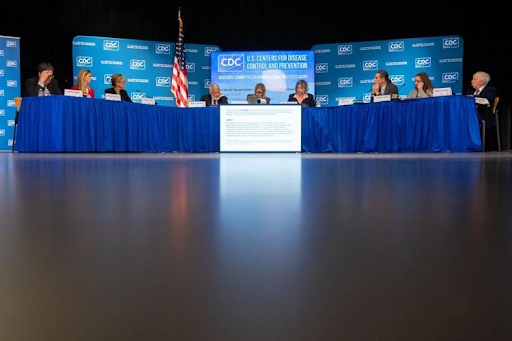
The CDC Advisory Committee on Immunization Practices meets in Atlanta on Friday, Dec. 5, 2025 to consider changes in hepatitis B vaccine recommendations for infants. (AP Photo)
A major shift is underway in U.S. vaccine policy. On Friday, a federal advisory committee voted to end the long-standing guidance that all newborns receive the hepatitis B vaccine at birth.
The decision immediately sparked concern among medical experts and public health officials. Many called the move reckless, pointing to the decades-long success of universal newborn vaccination in preventing liver infections.
“This is the group that can’t shoot straight,” said Dr. William Schaffner, a Vanderbilt University vaccine expert with years of experience on vaccine advisory committees.
Birth Dose No Longer Automatic
For more than 30 years, U.S. health authorities have recommended that all babies get the hepatitis B shot shortly after birth. The vaccine protects against a serious liver infection that can lead to lifelong complications, including liver failure and cancer.
Under the new guidance, the birth dose would be reserved for infants whose mothers test positive for hepatitis B or whose mothers’ status is unknown. For other babies, the decision will be left to parents and their doctors.
The committee voted 8-3 that if families choose to delay, the vaccination series should start at two months of age.
President Donald Trump praised the vote, calling it a “very good decision.” The acting CDC director, Jim O’Neill, will decide whether to adopt the recommendation.
Controversial Moves and Committee Changes
The advisory committee operates under the Centers for Disease Control and Prevention, offering guidance on how vaccines should be administered. Historically, CDC directors have followed their advice.
This year, Health Secretary Robert F. Kennedy Jr., a former anti-vaccine activist, replaced the entire 17-member panel with a new group, including several anti-vaccine voices. Kennedy’s appointees moved quickly to review the hepatitis B recommendation.
Committee member Vicky Pebsworth cited “pressure from stakeholder groups” as a reason for the change but did not name specific groups.
Many experts argued that the risk of infection for most babies is low, yet the safety of the vaccine in newborns has been extensively documented. Critics say the committee ignored decades of research showing the birth dose is safe and effective.
Scientific Concerns and Public Pushback
Some committee members questioned whether two months is a suitable starting point for the vaccine series. Dr. Joseph Hibbeln called the proposal “unconscionable,” citing a lack of data.
Another controversial proposal suggested parents consider testing infants’ blood to measure immunity after vaccination. Experts warned this approach is unnecessary and not standard pediatric practice.
Health specialists fear the shift could undermine public health, leaving more children vulnerable to preventable liver disease. “This makes America sicker,” said Republican Sen. Bill Cassidy, a liver doctor.
The committee’s approach focuses on individual risk rather than population-level protection. Critics, including Dr. Robert Malone, called this a dangerous departure from evidence-based vaccination policy.
Experts Speak Out
Some prominent vaccine scientists declined to present at the meeting. Dr. Peter Hotez of Texas Children’s Hospital refused, saying the committee had shifted away from science and evidence-based medicine.
Public health advocates described the session as an “epidemiological crime scene,” noting the committee no longer prioritizes scientific data.
As the acting CDC director reviews the recommendations, medical societies and state health departments have stated they will continue to advise the birth dose for all babies. Health insurers, meanwhile, confirmed coverage will continue for the vaccine at birth.
The decision signals a return to a strategy abandoned more than three decades ago. Whether it will reshape vaccination practices remains uncertain.