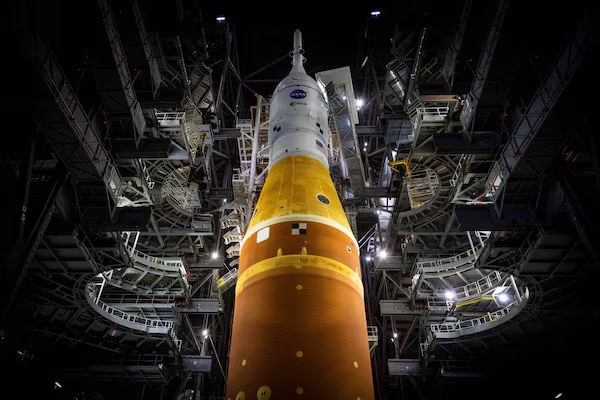
NASA is getting ready for an important milestone in space exploration as it moves closer to launching the Artemis II mission. The Globe & Mail
NASA is preparing for a major step in space exploration with the upcoming launch of Artemis II. The mission will send astronauts around the moon for the first time in more than five decades, marking a return to deep space travel not seen since the Apollo era.
The launch is scheduled for Wednesday, with final checks now underway.
Crew Set for Lunar Journey
Four astronauts will travel aboard the Orion spacecraft, named Integrity. The mission will last about 10 days and will take the crew farther from Earth than any human has travelled before.
Unlike earlier missions, the astronauts will not land on the moon. Instead, they will circle it and return home. This journey forms part of a larger plan to build a long-term human presence on the moon and prepare for future missions to Mars.
Among the crew is Jeremy Hansen from London, Ontario. He will become the first Canadian, and one of the first non-Americans, to take part in a mission of this kind.
Jenni Gibbons of Calgary will serve as the backup astronaut. She has completed the same training and will support the mission from Earth.
Excitement Builds Ahead of Launch
Officials say the team feels ready and eager. Jeff Spaulding, a test director involved in the mission, shared his confidence in the crew and staff.
“I think everyone’s pretty excited and understands the significance of this launch,” he said. “Our team has been working amazingly hard these past few weeks and months trying to get this vehicle ready to where it is.
“People are excited, and ready to go on this first chapter on our way back to the moon since the 1970s.”
He added that the team enjoys the work and remains fully committed to the mission.
Weather Conditions Look Favourable
Weather experts have also given encouraging updates. Mark Burger, a launch weather officer, said conditions appear suitable for liftoff.
“There’s nothing here that is screaming a no-go for the entirety of the window for any one of these attempts,” he said.
The launch window is set to open in the early evening, giving crews time to monitor conditions closely.
Delays Led to Final Readiness
The mission has faced several delays over the past few years. It was first expected to launch in late 2024, but technical concerns pushed the date back.
Engineers reviewed the Orion spacecraft after finding issues with its heat shield during a previous test flight. These checks helped improve safety and reliability before sending astronauts on board.
Despite the setbacks, officials say the extra time allowed teams to strengthen the mission.
“We’ve had some challenges, the team has done an outstanding job managing each and every one of those throughout all these scenarios,” Spaulding said.
Looking Ahead to Future Missions
Artemis II represents the next major step in a broader plan to return humans to the moon. Future missions aim to land astronauts on the lunar surface and eventually support longer stays.
The success of this mission will play a key role in shaping those plans.
As launch day approaches, attention now turns to the skies, where a new chapter in space exploration is about to begin.