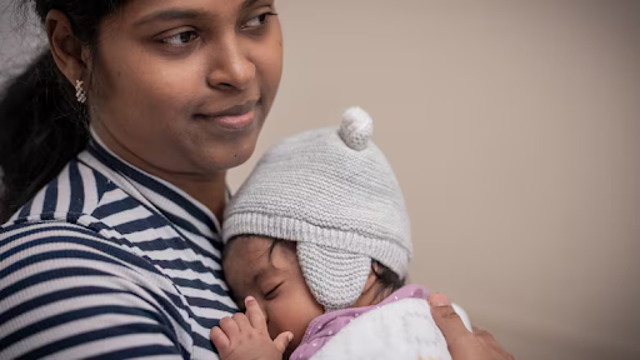
Nirmala Viswanathan embraces her daughter, Nila Lakshman, after Nila received nirsevimab to help protect her from RSV infection. (Turgut Yeter/CBC)
This year, Canada is facing a concerning rise in Respiratory Syncytial Virus (RSV) infections, particularly among babies under one-year-old. As of late November, data shows that nearly half of all RSV cases are in infants. Although Health Canada has approved a promising immunization to protect babies from this potentially dangerous illness, it’s only available in select regions, leaving many vulnerable infants without access to the protection they need.
RSV usually causes mild cold-like symptoms, but it can lead to severe health complications in newborns and older adults, often leading to hospitalization during the winter months. In fact, RSV is one of the top causes of seasonal hospitalizations for children across the country. According to Dr. Jesse Papenburg, a pediatric infectious disease specialist, approximately 10% of RSV hospitalizations require pediatric intensive care.
The immunization, known as nirsevimab, developed by AstraZeneca and distributed in Canada by Sanofi under the name Beyfortus, has been approved for use. This single-dose injection, which contains lab-made monoclonal antibodies, offers protection for infants throughout the fall and winter when RSV is most prevalent. It is also effective for toddlers, who remain vulnerable to the virus in subsequent years.
However, this lifesaving injection is only available in Ontario, Quebec, and the territories where provincial governments have negotiated contracts to provide it for free. In other regions, only high-risk infants qualify for the injection, leaving many parents feeling frustrated and concerned.
Hannah Markham, a mother from Nova Scotia, expressed her concern for her four-month-old baby this RSV season. "We feel left behind," she said, noting that she would like the same access to the shot that other provinces are offering.
While monoclonal antibody treatments like nirsevimab offer direct protection, vaccines generally work by prompting the immune system to produce its own antibodies, which could take longer. The National Advisory Committee on Immunization (NACI) has decided not to recommend nirsevimab for all infants at this time, citing the current high price of $952 per dose. Instead, the committee recommends prioritizing higher-risk infants, such as those born prematurely, while working toward a universal RSV immunization program for all babies in the future.
Canadian pediatricians are optimistic that nirsevimab can reduce RSV-related hospitalizations by up to 80%. Similar results have been seen in clinical trials and in countries such as the U.S., France, and Spain, where the shot was used in the previous year.
In some regions, existing immunization programs offer palivizumab, another monoclonal antibody for high-risk infants, but it is given monthly, unlike nirsevimab, which is a one-time injection. Despite this, many low-risk infants remain without any protection.
Dr. Filippe Scerbo, chief of pediatrics at Mackenzie Health in Vaughan, Ont., noted that his hospital has seen a significant increase in RSV cases, including severe cases with symptoms such as wheezing, difficulty breathing, and trouble eating. "It’s been a very challenging month," he said.
Sanofi, the distributor of Beyfortus, has stated that it is committed to ensuring wider access to the injection in the future, working with provinces to expand the program to include all infants by 2025.
As the RSV season continues, the hope is that more provinces will make the vaccine more widely available and that parents like Markham won’t have to feel anxious about their child's health this winter.