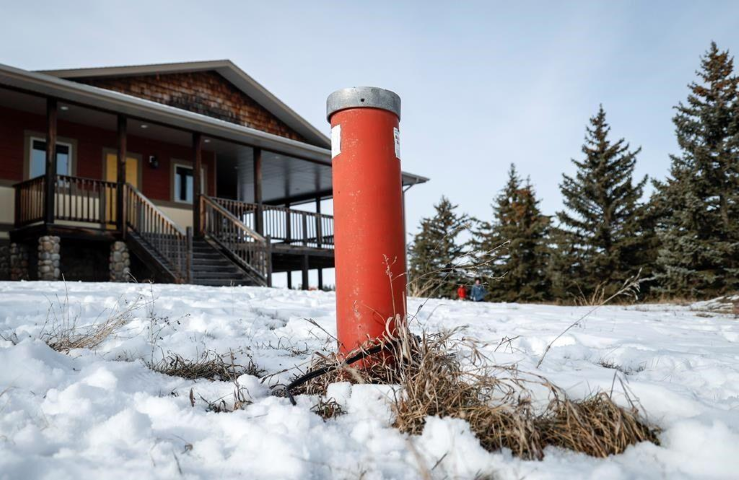
A water wellhead is pictured at home owner Henk de Haan's property near Okotoks, Alta., on Thursday, Feb. 22, 2024. THE CANADIAN PRESS/Jeff McIntosh


February 27, 2024

Henk de Haan recently discovered a hidden danger lurking in his acreage home near Calgary, where his children had been sleeping in the basement for five years. A friend's suggestion led him to test for radon, revealing a serious problem.

Radon, a radioactive gas formed naturally from the breakdown of uranium, thorium, or radium in rocks, soil, and groundwater, posed a risk in his home. Testing revealed radon levels at 400 becquerels per cubic meter, far exceeding Health Canada's safety limit of 200 becquerels.

To address the issue, de Haan installed a radon mitigation system, alleviating the danger. Despite the resolution, concerns linger, particularly as his wife is a breast cancer survivor who underwent a double mastectomy.

A study by University of Calgary researchers found a correlation between radon levels in rural homes and their proximity to drilled groundwater wells. According to Aaron Goodarzi, principal investigator of the study, radon travels more swiftly to the surface near these wells, increasing the risk for nearby rural homes.

The study, encompassing 42,051 Canadian households, revealed that rural communities generally face 30% higher residential radon levels compared to urban areas. Radon exposure ranks as the second leading cause of lung cancer in Canada and globally, emitting harmful alpha radiation that damages DNA.

Goodarzi emphasized the necessity of regular radon testing, especially in rural regions, to mitigate cancer risks. The study's findings underscore the importance for policymakers to address radon exposure as part of cancer prevention efforts.


How useful was this post?

Click on a star to rate it!

Average rating 0 / 5. Vote count: 0

No votes so far! Be the first to rate this post.

You may also like

Fuel Oil Spill Triggers Water Advisory in Minden Hills

A fuel oil spill in Minden Hills has prompted a drinking water advisory for residents relying on South Lake, after....

New Plant Serum Shows Faster Hair Regrowth Results

A team of scientists has developed a plant-based hair growth serum that has shown promising results in early clinical testing,....

Carfentanil Surge Sparks New U.S. Drug Crisis

A quiet life can unravel in seconds. For 36-year-old Michael Nalewaja, it did just days before Thanksgiving 2025. Living in....

From Plague to COVID: Study Reveals Persistent Inequality

A new study comparing victims of a 17th-century plague outbreak with modern-day COVID-19 cases has uncovered a striking pattern: social....

Cognitive Decline Breakthrough: Scientists Identify Single Protein and Potential Cure

A new study on cognitive decline is offering fresh hope by challenging the long-held belief that brain aging is irreversible.....

Common Antidepressant Shows Promise for Long COVID Fatigue

A widely used and affordable antidepressant may offer relief for one of the most persistent symptoms of long COVID—fatigue—according to....

COVID-19 Cicada Variant BA.3.2 Spreads Globally as Experts Monitor Mutation Risks

A new COVID-19 strain, widely referred to as the “Cicada” variant, is drawing attention as it gradually spreads across multiple....

Medication Costs Hit Black Canadians Harder, Study Finds

A new study has uncovered a troubling gap in Canada’s healthcare system: Black Canadians are significantly more likely to skip....

Meningitis B Vaccine Campaign Gains Urgency After Teen Death and Kent Outbreak

A grieving mother’s call for wider access to the meningitis B vaccine is gaining renewed attention as a recent outbreak....

P.E.I. Health Advocates Urge Ottawa to Act on Alberta’s Bill 11

Health advocates in Prince Edward Island are urging federal action against Alberta’s Bill 11, warning the controversial legislation could reshape....

COVID Still Disrupts Lives Years After Infection

For Mike Hall, life changed dramatically in the summer of 2022. What began as a COVID-19 infection for his wife....

Cancer Advocates Urge Colon Screening to Start at 45 in Canada

The Canadian Cancer Society is calling on provinces and territories to lower the starting age for colorectal cancer screening, citing....