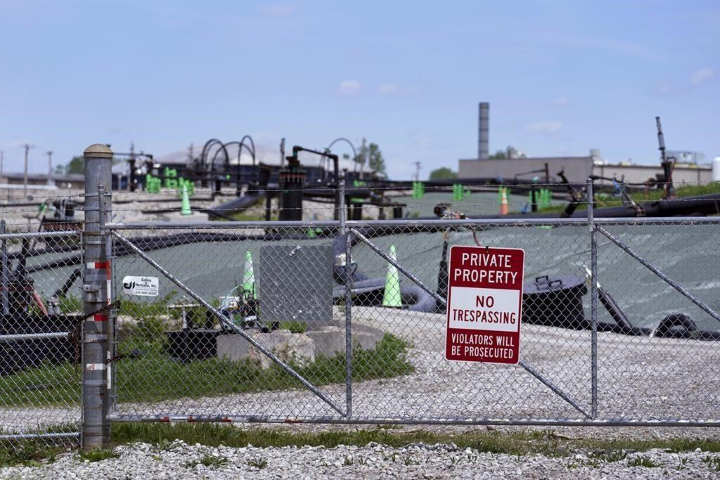
A "No Trespassing" sign is seen on a fence surrounding the West Lake Landfill Superfund site in Bridgeton, Missouri, on April 21, 2023. The Senate approved a bill renewing a law to compensate Americans exposed to government radiation, but its fate in the House remains uncertain. (AP Photo/Jeff Roberson, File)
The Senate approved a bill on Thursday aimed at compensating Americans exposed to radiation by the government, renewing a law passed over three decades ago. The legislation, introduced by Senators Josh Hawley, a Republican from Missouri, and Ben Ray Lujan, a Democrat from New Mexico, seeks to expand the Radiation Exposure Compensation Act (RECA) to include more individuals who believe they contracted illnesses due to exposure.
Despite concerns from some Republicans regarding the estimated $50 billion cost, both senators argued that the government bears responsibility and should provide support.
Before the Senate vote, Hawley joined advocates for the legislation outside the Senate chambers. Many of these advocates have battled cancer themselves or have family members diagnosed with illnesses potentially linked to radiation exposure. Hawley emphasized the government's obligation to support those affected, stating it's challenging to face them and deny assistance.
The bill passed the Senate with a vote of 69-30, with bipartisan support from 20 Republicans and all but two Democrats. However, its fate in the House remains uncertain.
Decades ago, uranium processing in the St. Louis area played a crucial role in developing nuclear weapons, contributing to contamination issues that persist today. An investigation by The Associated Press, The Missouri Independent, and MuckRock revealed overlooked health risks, spills, and storage problems at nuclear bomb production and atomic waste storage sites in the region.
Though linking illnesses definitively to the waste is difficult, advocates argue that ample evidence suggests its harmful effects on residents. Missouri State Representative Chantelle Nickson-Clark shared her personal experience as a two-time breast cancer survivor, underscoring the community's health challenges.
President Joe Biden previously extended RECA in 2022, but it expires in June. Hawley's bill proposes a five-year extension, expanding coverage to individuals in Missouri and several other states and territories.
While the White House expressed support for the legislation, concerns over costs persist. The Committee for a Responsible Federal Budget stressed the importance of budget offsets.
Advocates have long fought for broader RECA coverage, particularly in areas like New Mexico, where communities near the site of the first atomic bomb detonation faced health risks without warning. Tina Cordova, a cancer survivor and advocate for New Mexico downwinders, highlighted the historical significance of radiation exposure in her state.
The vote in the Senate, amid ongoing efforts to fund the government, reflects the bill's urgency. Senate Majority Leader Chuck Schumer prioritized the legislation amidst negotiations on the spending package.
Although Hawley did not confirm leveraging the spending bill for his legislation, he pledged to exhaust all avenues for its passage. However, gaining traction in the GOP-led House poses challenges.
Contamination concerns extend beyond Missouri, with St. Louis residents affected by waste from Coldwater Creek and uranium processing sites. The closure of a local grade school due to contamination underscored public health risks.
Despite setbacks in past negotiations, advocates view the bill's passage as a beacon of hope. For individuals like Christen Commuso, grappling with health issues and soaring medical costs, the legislation offers the promise of much-needed support and care.