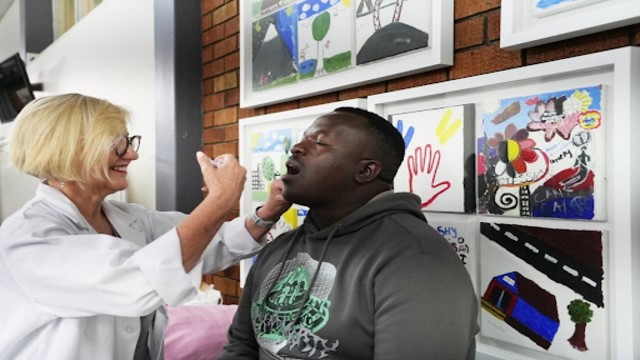
South African Medical Research Council head Prof Glenda Grey administers a cholera vaccine to Shadrack Makutu, a participant in the clinical trials for the vaccine developed by Biovac at the Chris Hani Baragwanath Hospital in Soweto, South Africa, Tuesday, Nov. 11, 2025. (AP Photo)
South Africa has begun clinical trials for its first domestically developed cholera vaccine — a breakthrough scientists hope will strengthen the continent’s fight against deadly outbreaks.
The oral vaccine, created by Cape Town-based pharmaceutical company Biovac, entered human trials this week to test its safety in adults. If successful, the vaccine will move to the next stage, where researchers will compare its effectiveness with existing cholera vaccines currently available worldwide.
Health Minister Aaron Motsoaledi announced that, based on early results, the vaccine could be approved for use in Africa by 2028.
A Milestone for Africa’s Vaccine Independence
The project marks a significant moment in Africa’s growing capacity to research and produce its own vaccines. Motsoaledi called the development a “major step toward reducing dependence on imported vaccines” — a weakness exposed during the COVID-19 pandemic when many African nations faced shortages.
“When we can research, develop, and manufacture vaccines locally, we reduce our vulnerability to supply chain disruptions and geopolitical pressures,” he said. “It ensures Africa is not left behind in times of crisis.”
Although South Africa records relatively low levels of cholera, neighboring countries such as Malawi, Mozambique, and Zimbabwe have endured severe outbreaks. In 2023, South Africa reported more than 1,400 cholera cases and 47 deaths, with the community of Hammanskraal, near Pretoria, hit especially hard due to poor access to clean water.
Trials Across Cholera-Prone Regions
The clinical trials are being conducted in Gauteng, Eastern Cape, and KwaZulu-Natal, provinces where cholera has been reported in recent years. Researchers will monitor participants closely to assess the vaccine’s safety and immune response.
“This development addresses a critical, life-saving need,” said Biovac CEO Morena Makhoana. “There’s an ongoing global shortage of cholera vaccines amid recurring outbreaks, and this innovation could help close that gap.”
Communities Welcome the Breakthrough
For many South Africans, the project represents more than a scientific milestone — it offers hope for safer communities.
Lerato Maleka, 44, one of the first participants in the trial, said she volunteered because of persistent water challenges in her area.
“I haven’t had cholera, but we know the risks,” she said. “People in Hammanskraal died from contaminated water. I joined the trial to protect myself and others.”
In Diepkloof, Soweto, Maleka added that residents often boil tap water before drinking, fearing contamination.
Another participant, Shadrack Makutu, 37, from Limpopo province, recalled a cholera outbreak in his village of Bushbuckridge. “Many people there share water sources with animals,” he said. “I know people who suffered from cholera. That’s why I wanted to take part.”
A Step Toward a Healthier Future
According to the World Health Organization (WHO), up to 4 million people worldwide contract cholera each year, and as many as 143,000 die from it.
If Biovac’s vaccine proves effective, it could transform access to life-saving protection across Africa — especially in regions still battling poor sanitation and limited healthcare infrastructure.
As trials progress, South Africa stands on the verge of delivering a homegrown solution to one of the continent’s oldest and deadliest diseases — a hopeful stride toward vaccine self-reliance and health security.