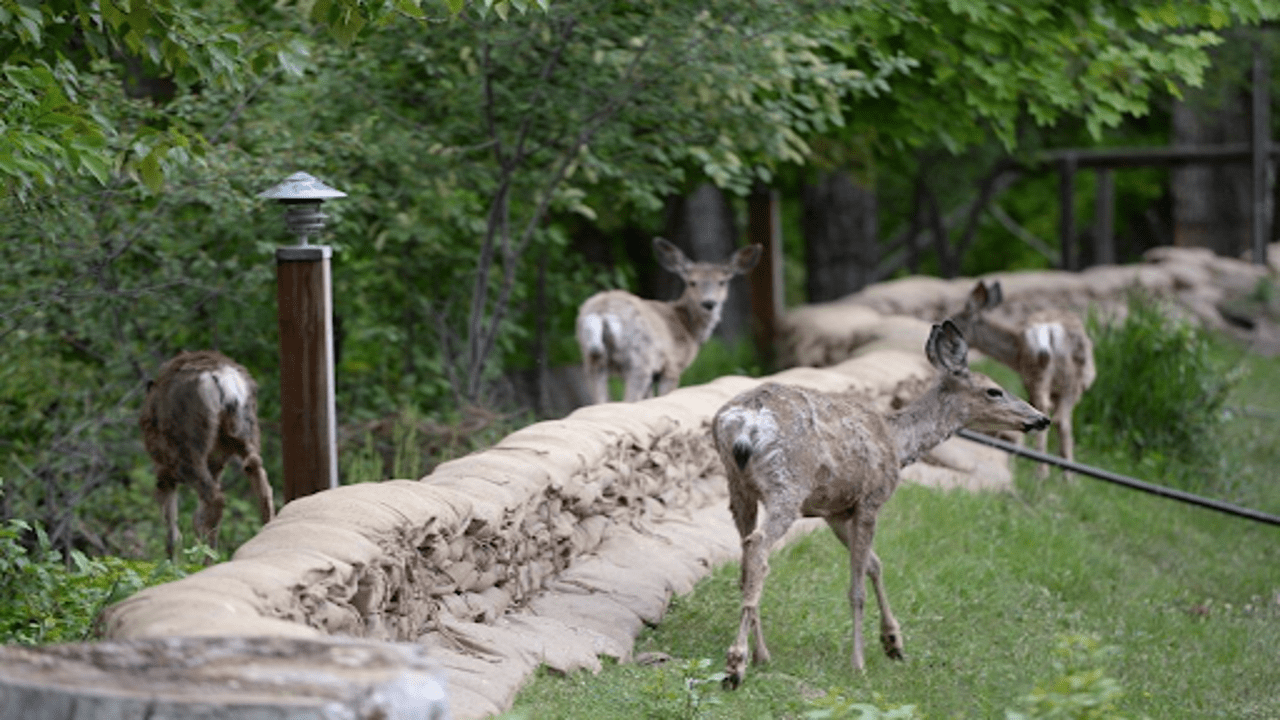
Deer walk near the Granby River in Grand Forks, B.C., on May 16, 2018. The B.C. government says officials have confirmed a new case of chronic wasting disease, a deadly disease for deer, in a white-tailed deer in the Kootenay region. THE CANADIAN PRESS/Jonathan Hayward
A third case of chronic wasting disease (CWD), a fatal illness threatening deer populations, has been confirmed in British Columbia. The B.C. Ministry of Water, Land and Resource Stewardship announced that the latest case involved a white-tailed deer hunted in the Kootenay region last month, bringing the total number of cases in the province to three. The first two cases were reported earlier this year in February.
The Canadian Food Inspection Agency’s lab confirmed the infection this week. The ministry noted that the infected deer was found within two kilometers of one of the earlier cases near Cranbrook.
Dr. Kaylee Byers, a health sciences professor at Simon Fraser University, commented on the proximity of the cases, calling it “the best news of bad news” since the disease seems to remain localized for now. “We’re already in an area where we’re focusing on managing these animals,” she said.
In response, the B.C. Wildlife Federation has called for a significant reduction in urban deer populations in the Kootenay region, describing these animals as a major factor in the spread of CWD. Jesse Zeman, the federation’s executive director, emphasized the urgency of the situation. “Urban deer in high-density areas pose a serious risk for CWD and other diseases,” Zeman said, adding that reducing their numbers near Cranbrook is a practical step.
The provincial government has already begun efforts to control urban deer populations in Cranbrook and Kimberley as part of a broader strategy to limit the disease's spread. Mandatory testing has also been introduced for deer, elk, and moose hunted in specific zones in the region. Earlier this year, a targeted hunt culled 50 deer, but no additional infections were detected.
CWD affects deer, elk, moose, and caribou, targeting their central nervous system and leading to fatal brain damage. The disease, first identified in Saskatchewan in 1996, is considered “indestructible” according to Byers. She stressed that early action, including culling, is critical to managing the disease's impact. “Removing a few now can save hundreds in the future,” she explained.
Despite these efforts, the B.C. Wildlife Federation has raised concerns about inadequate funding, warning that under-resourced programs could hinder detection and containment. The federation highlighted the lack of dedicated funding in the last provincial budget as a significant challenge.
Although there is no evidence that CWD can infect humans, Health Canada advises against consuming meat from infected animals, as cooking does not destroy the abnormal proteins responsible for the disease. Hunters are playing a key role in the fight against CWD by submitting samples to support surveillance efforts. “We rely on hunters to help track the disease,” Byers said. “Their participation is vital.”
The first two cases of CWD in B.C. this year involved a male mule deer hunted in February and a female white-tailed deer killed in a road accident. With the disease now confirmed in three cases, authorities continue to focus on prevention and containment.