TIME anoints 'Architects of AI' as person of the year.
Time magazine has declared the “Architects of AI” as its 2025 Person of the Year, marking a historic moment for artificial intelligence. The magazine said 2025 was the year when AI’s full potential “roared into view”, reshaping industries, culture, and global power structures with unprecedented speed.
Time emphasized that its choice honors the people behind AI—the leaders, researchers, and innovators who built the systems redefining modern life—rather than the technology itself.
Why Time Chose the “Architects of AI”
Time’s editors said the recognition reflects the individuals who “imagined, designed, and built AI,” calling them pioneers of a new era. Editor-in-chief Sam Jacobs noted that the publication has occasionally honored concepts before, such as the personal computer in 1982 or the endangered Earth in 1988.
However, this year felt different. According to Jacobs, AI reached a point of no return, embedding itself deeply into everyday routines and global decision-making. Consumers embraced AI tools at record speed, shifting the field from early experimentation to mainstream reliance.
The Faces Behind the 2025 Person of the Year
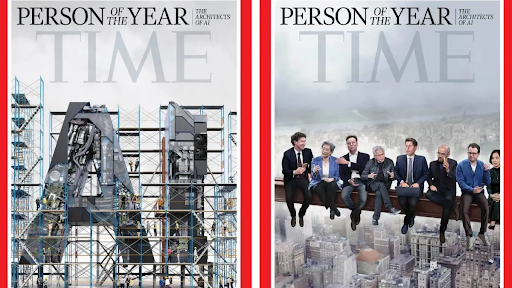
One of Time’s cover images recreates the iconic “Lunch Atop a Skyscraper” photograph, featuring eight leaders sitting on a steel beam:
- Mark Zuckerberg, CEO of Meta
- Lisa Su, CEO of AMD
- Elon Musk, CEO of Tesla
- Jensen Huang, CEO of Nvidia
- Sam Altman, CEO of OpenAI
- Demis Hassabis, CEO of Google DeepMind
- Dario Amodei, CEO of Anthropic
- Fei-Fei Li, AI pioneer and founder of World Labs
Another cover depicts massive AI-branded scaffolding, symbolizing the infrastructure of modern computing.
Five of the selected leaders—Musk, Zuckerberg, Huang, Altman, and Su—are already billionaires. Together, they hold an estimated $870 billion in wealth, much of it gained during the explosive AI boom of the past three years.
AI Moves Into the Mainstream
Research firm Forrester said Time’s decision reflects a major shift: 2025 was the year AI became mainstream. Analyst Thomas Husson said the technology moved from an early adopter novelty to an everyday tool shaping work, communication, entertainment, and political engagement.
Time also highlighted the symbolic presence of top AI CEOs at President Donald Trump’s inauguration earlier this year—an event that underscored AI’s rising influence in global governance.
Caution Surrounding the AI Revolution
While Time celebrated the innovation, experts continue to urge caution.
Anthony Aguirre, head of the Future of Life Institute, warned that leading AI companies are racing to automate nearly every facet of human life.
He said the impact could be “catastrophic” without strong ethical guardrails. The rapid expansion of AI raises concerns about job displacement, misinformation, privacy, and societal inequality.
Who Else Was Considered?
Prediction markets listed AI, Nvidia CEO Jensen Huang, and OpenAI’s Sam Altman as top contenders. Other major figures considered included:
- Pope Leo XIV, the first American pope
- President Donald Trump, recently re-elected and named Time’s 2024 Person of the Year
- Israeli Prime Minister Benjamin Netanyahu
- New York Mayor-elect Zohran Mamdani
Taylor Swift, the 2023 Person of the Year, was among those who set precedent for the magazine’s modern selections.
A Legacy of Defining Global Influence
Time has selected a Person of the Year annually since 1927, choosing the individual or group that most shaped news and global conversations. The publication, owned by Marc Benioff since 2018, maintains strict independence between ownership and editorial decisions.
Benioff, a longtime AI advocate, has called artificial intelligence “the most important technological wave of his lifetime,” though he does not influence the magazine’s editorial choices.
A Pivotal Moment for Artificial Intelligence
Time’s 2025 Person of the Year highlights a turning point. The Architects of AI are celebrated for building systems that astonish, disrupt, and redefine what is possible. Their work signals a future where AI is no longer optional—and where the world must navigate its benefits and risks with urgency.
The recognition marks a year when AI stepped irreversibly into the center of global affairs, shaping economies, culture, politics, and imagination.