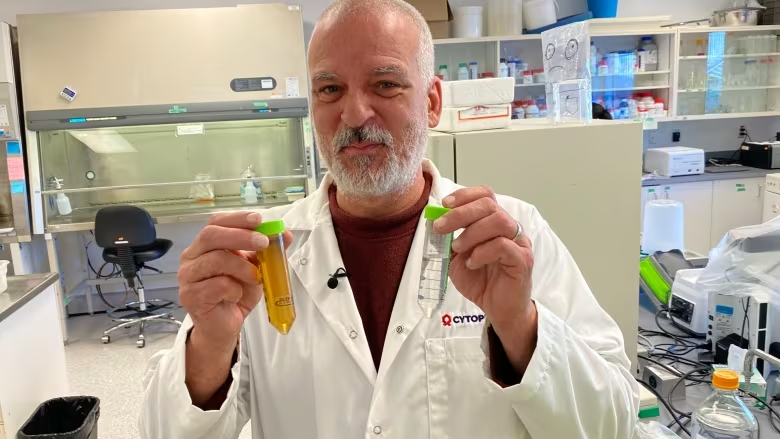
Cytophage owner and researcher Steven Theriault holding two vials of fluid— Lysed bacteria, left, from which phage is purified to create FarmPhage, right. Theriault believes he has the solution to an urgent global public health threat — antibiotic resistance. (Karen Pauls/CBC)
Steven Theriault, a former paramedic with a Ph.D. in molecular genetics and virology, has developed a potential solution to the global public health threat of antibiotic resistance using bacteria-killing viruses known as phages. These viruses bind to bacteria, inject their genetic information, and replicate until the bacteria bursts, destroying the host. While phages were discovered in 1915 and initially used to treat cholera, the advent of antibiotics in the 1940s overshadowed their use. However, the rise of antibiotic-resistant bacteria has renewed interest in phage therapy.
Theriault's company, Cytophage, focuses on modifying and genetically engineering phages to attack a broader range of bacteria, addressing the issue of their high specificity. These engineered phages could potentially combat antibiotic-resistant bacteria effectively. Notably, Theriault emphasizes that these phages cannot cause diseases in humans and only target bacteria.
The World Health Organization recognizes antibiotic resistance as a significant threat to global health, with nearly five million deaths associated with it in 2019. Antibiotic overuse in humans and animals is a primary cause of resistance, making infections harder to treat. Theriault's research initially targeted human resistance but expanded into agriculture, leading to the development of a product called FarmPhage.
FarmPhage is a cocktail of bacteriophages designed to kill E.coli and salmonella in chickens. Trials at the University of Saskatchewan's Vaccine and Infectious Disease Organization demonstrated a 92% survival rate for chickens infected with E.coli, compared to 8% in untreated birds. In Bangladesh, FarmPhage treatment resulted in a 22% increase in chicken protein content, a 12% reduction in required food, and faster growth.
Theriault has submitted FarmPhage for approval in the U.S. with plans to start selling in 2024. However, he faces challenges in gaining approval in Canada due to existing drug regulations that are not tailored to products like bacteriophages. Health Canada requires extensive trials, posing ethical concerns related to slaughtering animals given an unapproved drug.
The regulatory challenges and rigid framework in Canada are not unique to Cytophage. Lauren Carde, vice-president of operations and regulatory affairs at Paul Dick and Associates, emphasizes that Canada's regulatory system categorizes bacteriophages as drugs, hindering innovation in the industry. Carde argues for a more flexible approach that accommodates products like FarmPhage as non-drug alternatives.
While Theriault hopes to expand to the European Union and Australia, where regulatory frameworks are being developed, the current regulatory environment in Canada could lead innovative companies to abandon the market. The pressure to reduce antibiotic use emphasizes the need for regulatory changes to facilitate the adoption of alternatives like bacteriophages.