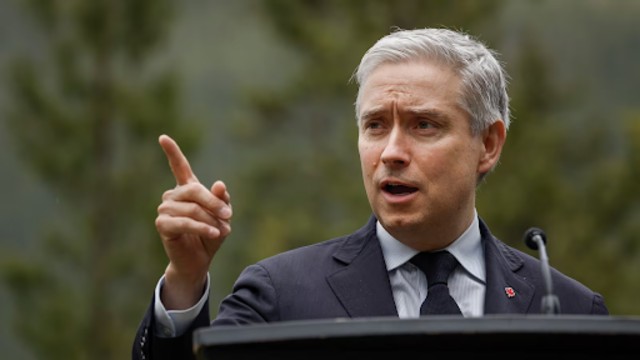
Canada's Finance Minister Francois-Philippe Champagne speaks to the media prior to the G7 Finance Ministers meeting in Banff, Alta., Tuesday, May 20, 2025. The Canadian press
As trade tensions mount and global markets face growing instability, Canada has issued a strong warning to fellow G20 nations: economic uncertainty cannot be allowed to take root as the new normal.
Speaking at the G20 finance ministers' meeting near Durban on Thursday, Canadian Finance Minister François-Philippe Champagne said global leaders must act collectively to restore confidence in the world economy.
Trade Tensions Cast a Shadow Over G20 Talks
The July 17–18 summit, attended by finance ministers and central bank governors from the world’s largest economies, has been overshadowed by trade disruptions, rising tariffs, and the absence of U.S. Treasury Secretary Scott Bessent. With former U.S. President Donald Trump’s protectionist policies still reverberating across markets, nations are struggling to find common ground.
Champagne said the word “uncertainty” dominated the opening day of discussions and warned that letting this uncertainty persist would erode investor and consumer confidence worldwide.
“We cannot allow uncertainty to become the new certainty,” he told Reuters, expressing cautious optimism that a final communiqué could still be reached.
A Call to Strengthen Confidence and Cooperation
The Canadian minister said it was vital for the G20 to send a clear, unified message that boosts both market stability and public trust. He emphasized the importance of working together on targeted areas like infrastructure investment and economic development, particularly in Africa.
Champagne, who will also chair a G7 meeting on Friday, stressed the need to focus on long-term strategies rather than short-term fixes.
“There are a number of things we can do collectively to restore confidence,” he said. “Investment in infrastructure and support for emerging regions are just the beginning.”
Africa Identified as a Key Player in Global Growth
Champagne highlighted Africa’s growing influence on the global stage. With a $3.4 trillion economy and a fast-rising young population, the continent presents both an opportunity and a responsibility for global leaders.
Describing Africa as “in many ways the future,” he urged G20 members to engage more deeply with African economies to support inclusive development.
He noted that attracting investment to the continent would require governments to prioritize three critical pillars: stability, predictability, and the rule of law.
“I’ve invited a number of African countries to formalize growing investment protection agreements,” Champagne said, adding that investor confidence would only come when transparent systems were in place.
Shifting Trade Routes and Global Alliances
Champagne also pointed to a major rebalancing in global trade. With more restrictions and tariffs in play, countries are diversifying supply chains, forming new alliances, and even exploring alternate shipping lanes.
This shift, he noted, presents a chance for economies to innovate and adapt, but it also increases the need for global cooperation.
“There’s a new world emerging,” he said. “But we need to shape it, not just react to it.”
A Push for a Unified G20 Message
Despite ongoing disagreements, Champagne expressed hope that the G20 would conclude with a strong, consensus-based statement.
For Canada, the priority remains clear: avoid turning short-term turbulence into long-term instability. Whether through renewed investment or broader international partnerships, Champagne believes there’s still room for optimism—if the world’s biggest economies work together.