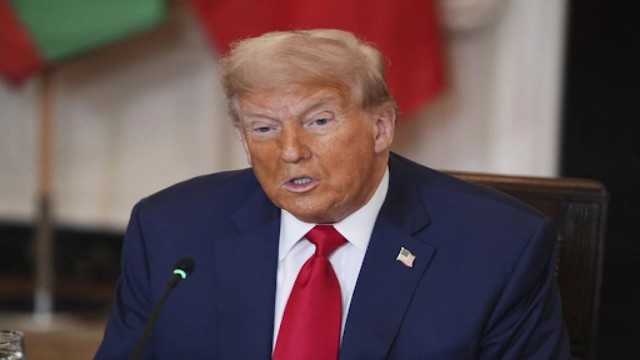
U.S. President Donald Trump addresses African leaders during a lunch held at the White House’s State Dining Room on Wednesday, July 9, 2025, in Washington. (AP Photo/Evan Vucci)
The Canadian pharmaceutical industry is expressing serious concern after former U.S. President Donald Trump suggested a massive 200% tariff on imported medicines. While Canada may not be the direct target, experts warn that Canadian drugmakers could still suffer major consequences if such sweeping tariffs are enforced.
Jim Keon, President of the Canadian Generic Pharmaceutical Association, clarified that Canada is likely collateral damage, not the bullseye. However, if the proposed tariff covers all pharmaceutical imports, Canadian companies—especially those producing generic medicines—could be hit hard.
Trump’s tariff proposal came to light Tuesday when he floated the idea during a speech, offering drug manufacturers a grace period of up to 18 months before the tariffs would kick in. The move follows an April investigation launched under Section 232 of the Trade Expansion Act of 1962. The investigation, citing national security concerns, focused on America's dependency on drug imports—many of which come from India and China.
A full report from the U.S. Commerce Department hasn't been released yet, but Commerce Secretary Howard Lutnick mentioned that more details on these tariffs could arrive by the end of the month.
In the U.S., generic drugs make up about 90% of all prescriptions. Canadian exports to the U.S., however, account for less than 5% of that market. Keon believes this minimal share should eliminate fears of overdependence on Canadian imports.
Still, the uncertainty lingers. Talks between Canada and the U.S. are underway to finalize a comprehensive economic and security agreement, with July 21 set as the target completion date. Keon hopes these negotiations will keep pharmaceuticals off the tariff list altogether.
“We’ve learned not to panic,” Keon said. “Often, what’s said publicly changes when actual policy decisions come out.” However, if Canada is not exempted, he warns it could spell trouble for both Canadian companies and international firms operating within Canada.
Generic drug production already runs on thin profit margins. Losing access to the massive U.S. market could force Canadian manufacturers to discontinue the production of certain essential medicines, potentially leading to supply issues at home.
On the other side of the border, American consumers might also feel the pinch. Higher tariffs would likely lead to drug shortages and increased costs in the U.S., according to pharmaceutical makers.
Keon emphasized that tariffs could disrupt a decades-old, stable supply chain that has operated without such barriers. “This move would complicate how medicine moves between countries and drive up prices for everyone,” he said.
Despite concerns over the tariffs, Keon acknowledged some positive efforts from the Trump administration—particularly separate studies aimed at reducing drug prices and making the U.S. a more attractive place for pharmaceutical production.
He suggested that, rather than slapping on tariffs, a better strategy would be to align U.S. drug regulations more closely with those of other nations. Doing so, he noted, would cut red tape and lower manufacturing costs without hurting global supply.