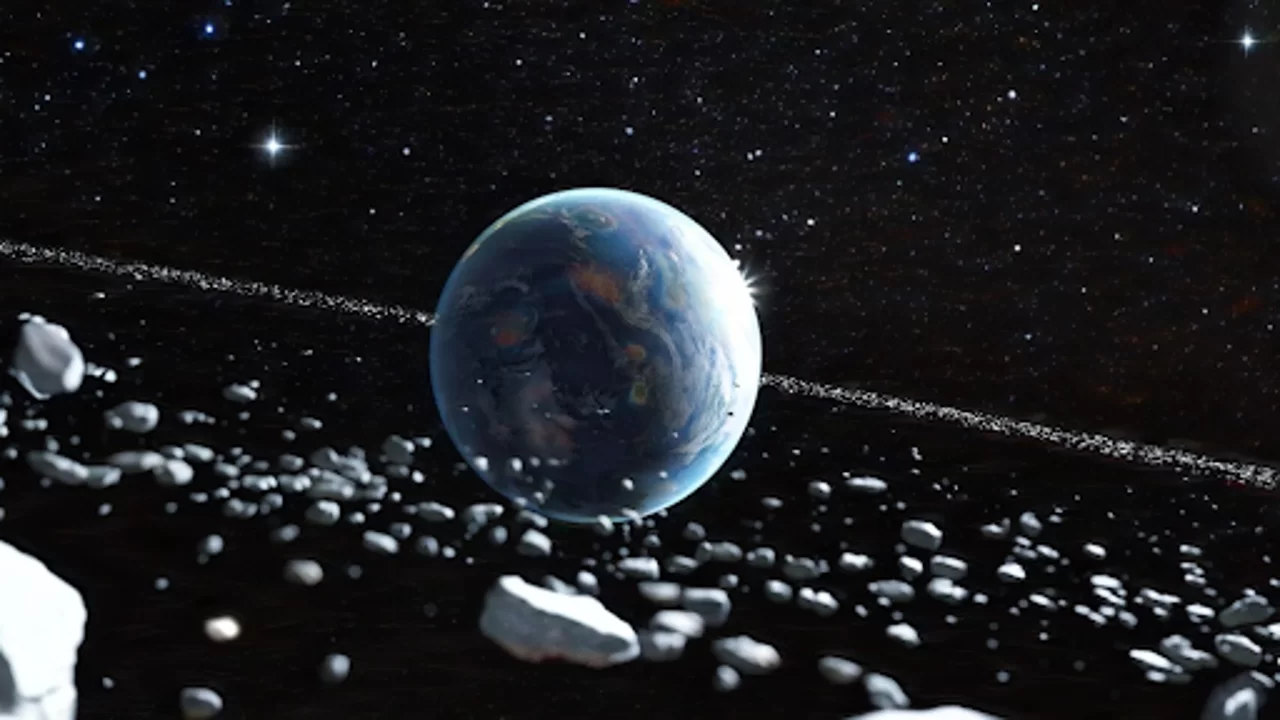
A recent study suggests that about 466 million years ago, a large asteroid may have been torn apart by Earth's gravity, potentially creating a ring around the planet similar to Saturn's. CNN
Saturn is famous for its stunning and vast ring system, but scientists are now considering a fascinating possibility: Earth may have had its own ring system about 466 million years ago, during the Ordovician Period. This period was marked by significant changes in the Earth's life forms, climate, and plate tectonics, and a surge in meteorite impacts that left scientists scratching their heads. A new study published in the journal Earth and Planetary Science Letters suggests that a rocky ring could have been the source of these meteorite strikes.
The Ordovician Period saw nearly two dozen impact craters, all of which were found within 30 degrees of the equator. This unusual concentration led researchers to hypothesize that these impacts may have come from meteoroids that fell from a ring surrounding Earth. According to the study’s lead author, Andrew Tomkins, a geologist from Monash University, it is highly unusual for 21 craters to be so close to the equator. "They should be randomly distributed," Tomkins said. "This suggests something more systematic, like a ring."
Beyond explaining the meteorite impacts, this hypothesis may also shed light on an even greater mystery: the global deep freeze that occurred around the same time. This dramatic cooling event, known as the Hirnantian Age, is one of the most extreme climate events in Earth’s history. Scientists believe that the shadow of this hypothetical ring might have caused the drastic drop in global temperatures.
Tomkins and his team are working to understand more about the potential ring and its impact on Earth’s history. Such a ring could not only explain the meteorite strikes but also help researchers understand how the planet’s climate and evolutionary development were influenced by the challenges brought on by a potential ring.
So, how could this ring have formed? Scientists explain that when an object, such as a large asteroid, ventures too close to a planet, it reaches the Roche limit. This is the distance where the planet's gravity is strong enough to pull the object apart. The broken pieces then form rings, like Saturn’s. In this case, scientists believe a large asteroid about 7.5 miles (12 kilometers) in diameter may have crossed Earth’s Roche limit, leading to the formation of the ring. The debris from this asteroid would have orbited around Earth, likely creating a ring similar to those around other giant planets in the solar system.
The researchers found that the 21 impact craters from the Ordovician Period were all near the equator. This is especially noteworthy because only 30 percent of Earth’s land surface was near the equator, making it highly unlikely that the impacts would have been random. Tomkins also pointed out that a previous study found evidence of this meteorite spike only on Earth, further supporting the ring hypothesis.
Additional evidence for the ring theory comes from deposits found on Earth that date back to the same period as the craters. These deposits contain high levels of L-chondrite, a type of meteorite material, which shows signs of having been exposed to space weather. This suggests that an asteroid, possibly weakened by previous collisions, broke apart near Earth, contributing to the meteorite strikes.
Several million years after this period of increased impacts, Earth experienced a global climate shift, with temperatures plunging during the Hirnantian Age. The debris from the asteroid’s breakup, possibly from a ring, could explain the sudden cooling. Tomkins hopes further research will reveal how long the ring might have lasted and how it influenced the evolutionary changes Earth underwent during this period.
The idea of Earth having had a ring system might sound far-fetched, but the possibility is real. Tomkins speculates that such a ring would have been visible from Earth, especially from the night side of the planet, creating a spectacular sight.
While rings are typically associated with outer planets, like Saturn, researchers believe that Mars could one day have rings too. As for Earth’s ring, Tomkins and his team believe this event may have happened only once in the last 500 million years, and its impact on the planet’s history may have been significant.