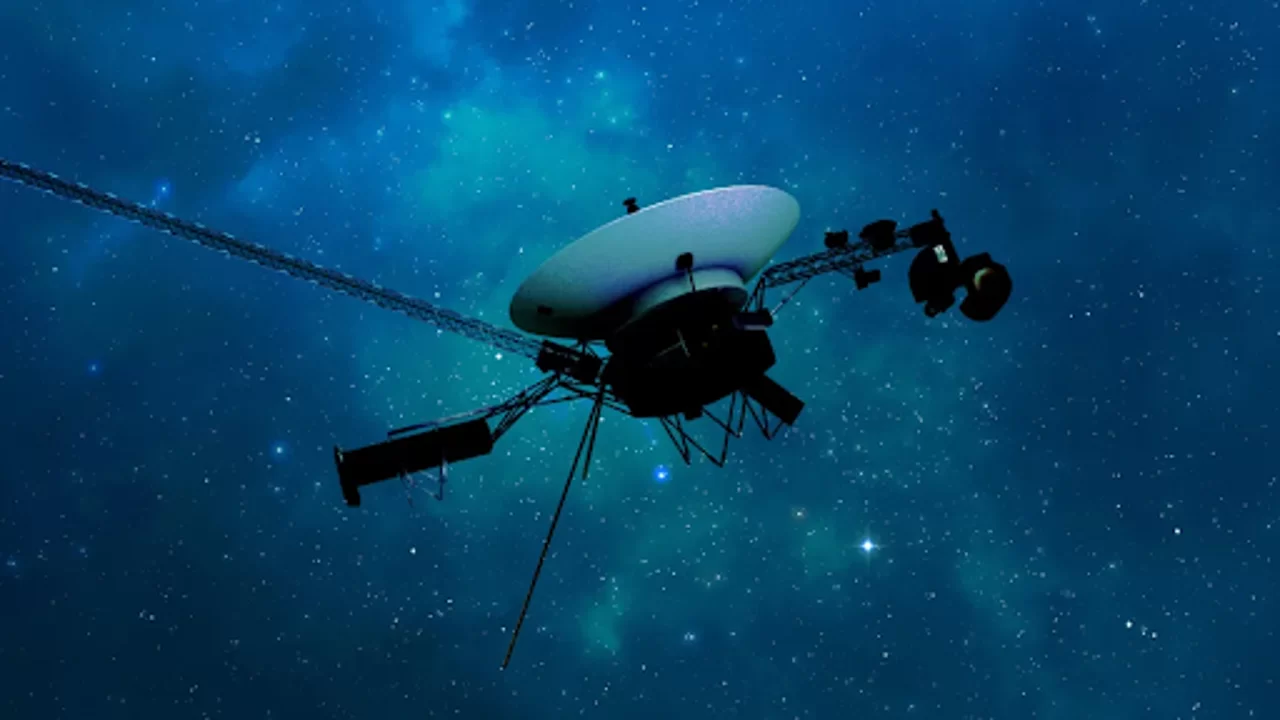
An artist's illustration shows NASA's Voyager 1 spacecraft as it journeys through interstellar space, the vast area between stars that it entered back in 2012. NASA
NASA's Voyager 1 spacecraft, which has been exploring space for 47 years, is back in contact with its team on Earth after a communications blackout. The probe is currently over 15 billion miles away in interstellar space and is now using a radio transmitter that hasn’t been utilized since 1981 while engineers work to resolve the recent technical issues.
Launched in September 1977, Voyager 1 is the most distant human-made object, operating beyond the heliosphere—the protective bubble of solar particles and magnetic fields surrounding our solar system. This unique position allows the spacecraft to gather valuable data from interstellar space. As Voyager 1 ages, its team has been shutting down non-essential systems to conserve power and ensure it can continue sending back scientific information.
Recently, the spacecraft faced a new challenge when a command was sent to activate one of its heaters. This heater is crucial for warming components that have been damaged by radiation over the decades. However, on October 16, something triggered Voyager 1's autonomous fault protection system, which automatically turns off non-essential systems to save energy if the spacecraft draws too much power.
When engineers tried to communicate with Voyager on October 18, they were unable to receive its response. They soon learned that the fault protection system had activated, possibly reducing the data transmission rate from the probe. This change altered the nature of the signals sent back to Earth, complicating communication.
Despite these hurdles, the team was able to detect a faint signal from Voyager 1 later that day. However, communication was completely lost on October 19. The team suspects that the fault protection system had been triggered several times, leading to the shutdown of the primary X-band transmitter, which has been used for decades. This caused Voyager to switch to the S-band transmitter, which operates at a lower frequency and has a much weaker signal.
After the team realized that the S-band signal could still be detected despite the probe's distance, they decided to wait before sending commands to re-activate the X-band transmitter. They need to understand what caused the fault protection system to engage to avoid further issues. Engineers are proceeding with caution, aware that they need to ensure there are no risks involved in reactivating the more powerful transmitter.
As part of their efforts, engineers communicated with Voyager 1 on October 22 to confirm that the S-band transmitter was functioning and received a positive response two days later. However, this solution is only temporary. “The S-band signal is too weak to use long-term,” noted Bruce Waggoner, the Voyager mission assurance manager. Although the S-band allows them to send commands and ensure the spacecraft is still oriented toward Earth, it is not suitable for receiving telemetry data or scientific information.
This situation is just one of many challenges faced by the Voyager team this year. They have successfully implemented innovative solutions to maintain communication, including using old thrusters to keep the antenna aligned with Earth and resolving a previous computer glitch that interrupted the flow of scientific data.
As engineers continue to investigate the latest issues, they remain hopeful that Voyager 1 will return to its regular operations and continue its incredible journey through the cosmos, providing invaluable insights about the universe.