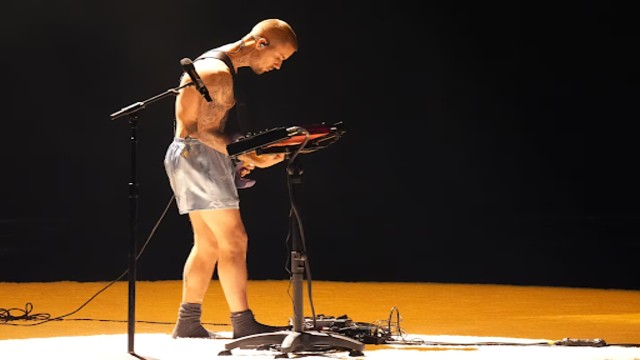
Justin Bieber performs "Yukon" during the 68th annual Grammy Awards on Sunday, Feb. 1, 2026, in Los Angeles. (AP Photo)
The 2026 Grammy Awards unfolded as a striking blend of artistry, protest, and spectacle, reflecting a sharply divided cultural moment in the United States. While several winners used the stage to criticize the Trump administration’s immigration policies, it was Justin Bieber’s unexpected, near-naked performance that dominated conversation and headlines.
The pop star returned to the Grammys stage after a four-year absence wearing only boxers and socks, delivering a minimalist performance that immediately drew attention across social media and the industry.
Bieber returns after health setback
Bieber’s appearance marked his first major live performance since being diagnosed with Ramsay Hunt syndrome in 2022, a condition that temporarily paralyzed part of his face and forced him to step back from public performances.
Despite the subdued styling, the performance carried emotional weight. Bieber performed a soulful track from his album Swag, keeping the staging sparse and intimate. Cameras cut to his wife, Hailey Bieber, visibly emotional in the audience, underscoring the personal nature of the moment.
Although Bieber entered the night with four nominations, including Album of the Year and Best Pop Solo Performance, he did not take home any awards.
Immigration protests shape the ceremony
Beyond music, the Grammys became a platform for political expression. Several artists openly criticized the Trump administration’s ongoing immigration crackdown, with repeated references to U.S. Immigration and Customs Enforcement (ICE).
Bad Bunny, one of the night’s biggest winners, used his acceptance speech to denounce mass deportations, saying, “We are humans and we are Americans.” He later secured Album of the Year and Best Global Music Performance for EoO.
Billie Eilish and other performers echoed similar sentiments, while “ICE Out” buttons appeared throughout the audience. Hailey Bieber and Joni Mitchell were among those seen wearing the protest symbol.
Canadian artists dominate major categories
Canadian talent had a strong showing throughout the evening. Halifax-raised producer Henry Walter, known professionally as Cirkut, won Producer of the Year and Best Dance Pop Recording for Lady Gaga’s “Abracadabra.”
Walter was recognized for his work on Gaga’s album Mayhem, as well as collaborations with The Weeknd, Bruno Mars, and Rose. His acceptance speech focused on trust and creative collaboration rather than politics.
Sound mixer Serban Ghenea also won alongside Walter, while Toronto professor Justin Gray made history as the first Canadian to win Best Immersive Audio Album for Immersed, a project featuring 38 Toronto-based artists.
Joni Mitchell delivers rare public appearance
One of the evening’s most warmly received moments came from legendary singer-songwriter Joni Mitchell, who appeared publicly to accept Best Historical Album for Joni Mitchell Archives – Volume 4.
At 82, Mitchell shared anecdotes from her career, including a humorous story about a rejected album cover sketch that eventually appeared on a Sunset Boulevard billboard. Her speech avoided politics but drew laughter and admiration from the audience.
Trevor Noah keeps the tone light
Host Trevor Noah balanced the evening’s heavy themes with humor, including a playful jab at rapper Drake during his opening monologue alongside Kendrick Lamar. His approach helped maintain levity amid emotionally charged speeches.
A Grammys night defined by contrast
The 2026 Grammys will be remembered not just for awards, but for contrast—between music and protest, glamour and restraint, celebration and critique. Justin Bieber’s stark stage return became the night’s visual symbol, while political statements underscored how deeply entertainment and national debate continue to intersect.