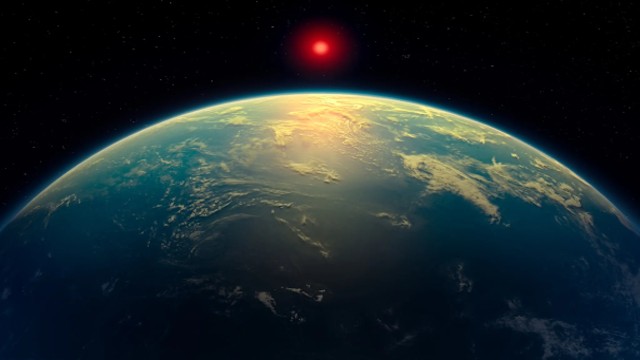
An artist's depiction of K2-18b, a distant planet that might support life. The New York Times
Scientists have discovered new, but still uncertain, evidence suggesting that life might exist on a far-off planet. A research team from Cambridge University has been studying a planet called K2-18b, which is located around 700 trillion miles away from Earth. The team believes they’ve found signs of molecules in its atmosphere that could indicate the presence of life.
This is the second time that chemicals related to life have been detected on K2-18b using the powerful James Webb Space Telescope. However, both the researchers and other astronomers agree that more data is needed to confirm these findings.
The lead researcher, Professor Nikku Madhusudhan, explained that they are hopeful the results could be confirmed within the next one to two years. “This is the strongest evidence yet that there might be life out there,” he said.
K2-18b is much larger than Earth, about two and a half times its size. It orbits a small red sun and is located far beyond our solar system. Using the James Webb Space Telescope, scientists can analyze the chemical makeup of the planet's atmosphere by studying the light that passes through it.
The Cambridge team has detected the presence of two specific molecules: dimethyl sulphide (DMS) and dimethyl disulphide (DMDS). On Earth, these molecules are produced by marine plankton and bacteria. “The amount we estimate of this gas in the atmosphere is thousands of times higher than what we have on Earth,” said Professor Madhusudhan. If this connection to life is confirmed, it would suggest that K2-18b could be teeming with life.
The researchers are excited by these results but are also cautious. The detection of these molecules is not yet conclusive. For the evidence to be accepted by the scientific community, the researchers need to be about 99.99999% sure that their findings are accurate. This level of certainty is known as a five-sigma result. Right now, their confidence is at three sigma, or about 99.7%. While this is significant, it’s not enough to claim a discovery of life.
In addition to this, even if the results are confirmed, it won’t necessarily prove that life exists on K2-18b. According to Professor Catherine Heymans, an independent astronomer from Edinburgh University, there’s still the question of how these gases were produced. “On Earth, they are produced by microorganisms in the ocean, but even with perfect data, we can’t say for sure that this is of biological origin on an alien world,” she explained.
The Cambridge team agrees with this view. They are working with other research groups to understand whether these molecules could be produced through non-biological means. Other scientists have also suggested alternative explanations for the data, including theories about the planet’s composition. Some believe the planet could have an ocean of molten rock, which would make life impossible.
Despite these challenges, Professor Madhusudhan remains optimistic. “Decades from now, we may look back and recognize this as the moment when the living universe came within reach,” he said. He believes this research could be the tipping point in answering the age-old question of whether life exists beyond Earth.
This groundbreaking research has been published in The Astrophysical Journal Letters.