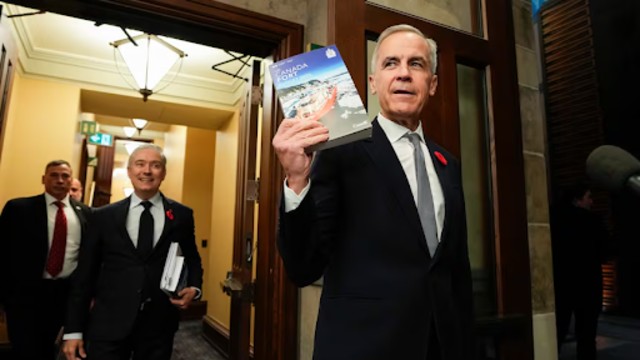
Prime Minister Mark Carney holds up a copy of his first budget on Tuesday. (The Canadian Press)
The federal government has released its first major budget under Mark Carney, introducing $141 billion in new spending to shore up a tariff-hit economy while trimming bureaucracy and public service numbers to rein in costs.
Finance Minister François‑Philippe Champagne tabled the budget, which forecasts a deficit of roughly $78 billion for 2025-26. That figure, while lower than some expectations, is still significantly higher than pre-trade-war projections.
Economy Under Pressure
The 406-page document sketches a sobering economic landscape. Unemployment is rising, business uncertainty has surged and productivity growth is weak. The government now projects growth of just about one per cent annually over the next two years — well below last year’s forecasts. In his address, Champagne warned: “The level of uncertainty is higher than what we have seen and felt for generations. Bold and swift action is needed.”
Major Investments and Key Priorities
At the heart of the budget are heavy-duty investments in infrastructure, housing, defence and business tax incentives. Among the highlights:
- $51 billion targeted at infrastructure over the next five years.
- A military funding package of $81 billion, under a new “Buy Canadian” procurement strategy.
- A “productivity super-deduction” to allow companies to immediately write off significant capital investments — aiming to deliver the lowest corporate marginal tax rate in the G7.
- A new $2 billion “critical minerals sovereign fund” and a $925 million artificial intelligence fund.
- A new federal housing agency, with an initial $13 billion over five years to accelerate factory-built homes and other affordable units.
Major project ambitions include high-speed rail between Toronto and Quebec City, expanded port infrastructure in Churchill, Manitoba, and an Alberta-based carbon capture and storage system. The plan aims to fast-track approvals and halve construction start times.
Cuts, Savings, and Structural Reshaping
To offset some of the spending, the government plans to implement roughly $51.2 billion in cuts and savings over the next five years — part of a broader target of $60 billion. Key measures:
- Downsizing the public service from a peak of 368,000 to about 330,000 employees by 2028-29 through buy-outs and attrition.
- Scaling back programs such as the two-billion-trees initiative, reducing veteran medical-cannabis coverage, changing public-sector pension inflation indexing, consolidating diplomatic properties and reducing foreign aid to pre-pandemic levels.
- Halving temporary immigration levels for students and foreign workers, and signalling abandonment of a previously proposed emissions cap — moves intended to boost domestic labour and energy sectors.
Debt-servicing demands are rising, with servicing costs projected at $55.6 billion this year. Yet experts say the situation is manageable. “Every country in the G7 would gladly trade positions with Canada,” said Sahir Khan, former deputy parliamentary budget officer. “There is no fiscal crisis and we’re not on any precipice.”
Political Backdrop and Reception
The minority Liberal government holds 169 seats in the House of Commons and needs opposition support to pass the budget. Thus far, the opposition’s reactions have been mixed. Conservatives have pledged to reject the budget, citing the large deficit and impact on the cost of living. The Bloc Québécois and NDP have raised concerns over regional and social investment shortfalls.
A Shift in Focus
Observers note the budget marks a pivot from social-program priorities to industrial and infrastructure investment, described by Khan as a shift from tax and transfer models to strategic capital deployment. The government is betting that large-scale, targeted investment and a competitive tax environment will spur private-sector growth and anchor jobs at home amid global economic turbulence.
With optimism hanging on execution and implementation, the government has framed this budget as the start of a new era of Canadian economic strategy — national ambition meeting uncertain international headwinds.