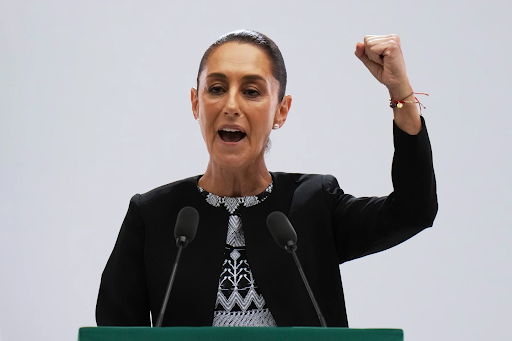
Mexican President Claudia Sheinbaum speaks at her first state-of-the-nation address at the National Palace in Mexico City, Sept. 1, 2025.
Mexico has announced a bold national initiative: the creation of Latin America’s most powerful supercomputer. The project aims to position the country at the forefront of artificial intelligence and advanced data processing, marking a major step in its digital transformation strategy.
Mexico Moves Toward Supercomputing Leadership
The government revealed that the new supercomputer, named “Coatlicue”, will surpass all existing systems in the region. The machine will be seven times more powerful than the current leader housed in Brazil.
Officials say this leap in computing power will help Mexico accelerate innovation in AI, data analytics, scientific research, climate modeling, and advanced engineering.
“Coatlicue”: A Name Rooted in Heritage
The supercomputer is named after Coatlicue, the Mexica earth goddess. The symbolic name reflects the country’s intention to grow its technological ecosystem and harness the power of digital transformation.
José Merino, head of the Telecommunications and Digital Transformation Agency, said the project will redefine Mexico’s computational capacity. He noted that the country's strongest machine today functions at 2.3 petaflops, while Coatlicue will reach 314 petaflops—a dramatic increase that highlights its potential.
Petaflops measure how many quadrillion operations a computer can process per second, showing the scale and speed Coatlicue will deliver.
President Sheinbaum: “A New Era for Mexico’s AI Future”
President Claudia Sheinbaum, a respected academic and climate scientist, shared her enthusiasm during her daily briefing. She confirmed that the exact location of the facility is still being evaluated but said construction will begin next year.
“We’re very excited,” Sheinbaum said. “This supercomputer will finally allow Mexico to fully participate in the rapidly expanding world of artificial intelligence and large-scale data processing. We currently lack the capacity for such advanced tasks, but Coatlicue will change that.”
Her comments underline the government’s commitment to bridging the technological gap and competing with global AI powerhouses.
Transformational Impact on Research and Technology
The plan for Mexico’s most powerful supercomputer aligns with the country’s broader digital modernization goals. Coatlicue is expected to support:
- AI model training and development
- Climate and environmental simulations
- Medical and genetic research
- Cybersecurity and digital policy innovation
- High-performance academic research
Experts believe the project will strengthen national capabilities and attract global collaboration in advanced computing.
The investment also highlights Mexico’s intention to reduce its dependence on foreign computing infrastructure, ensuring long-term technological sovereignty.
Closing the Digital Gap in Latin America
With Coatlicue, Mexico aims to lead Latin America in supercomputing. The dramatic boost from 2.3 petaflops to 314 petaflops marks a transformative step—one that could reshape the region’s competitiveness in AI and digital innovation.
As AI expands globally, supercomputers like Coatlicue are becoming essential national assets. Mexico’s decision to build the continent’s most powerful system signals its readiness to embrace the future, empower researchers, and build a stronger digital economy.