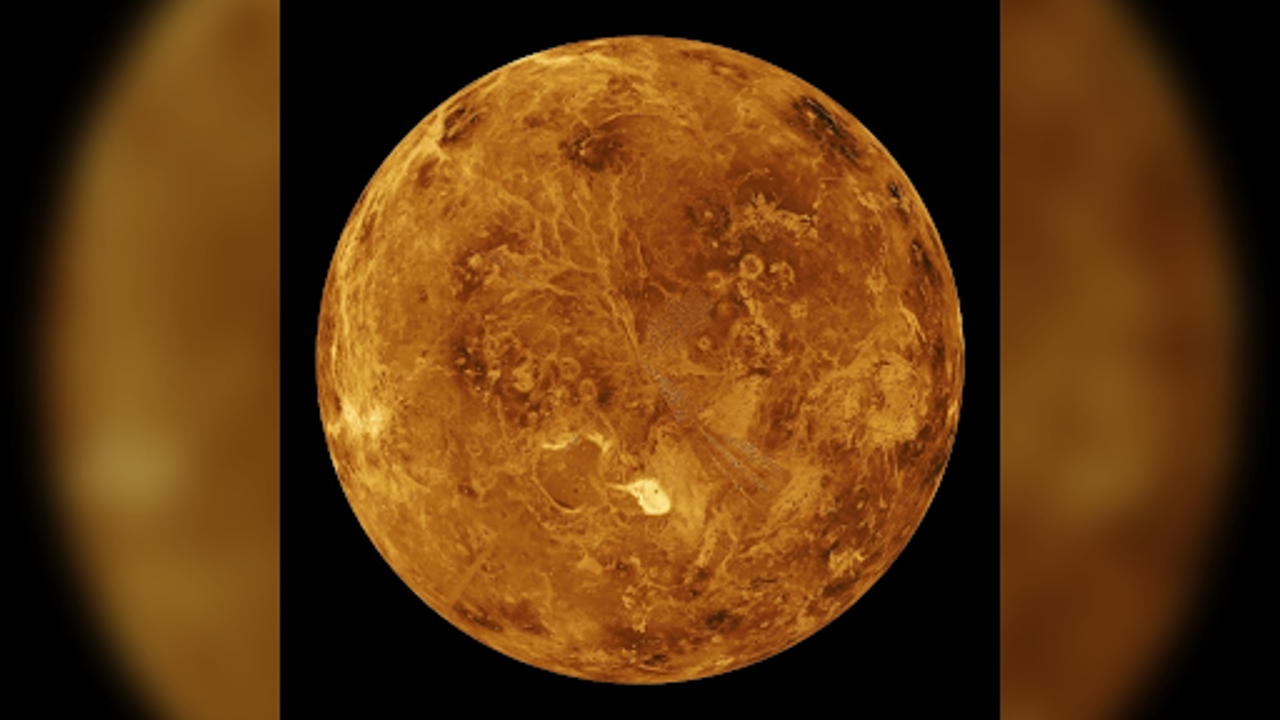
This image, taken by NASA's Magellan spacecraft in 1996, shows Venus' northern hemisphere. (NASA)
Four years ago, scientists made a surprising discovery in the clouds of Venus: a gas called phosphine, which on Earth is usually associated with life. This finding sparked a lot of debate, especially since follow-up observations didn't confirm the initial results. However, the original team has now come forward with new data that seems to bolster their original claim.
The researchers, presenting their findings at a Royal Astronomical Society meeting in Hull, England, on July 17, say they have stronger evidence of phosphine in Venus's atmosphere. The data were collected using a new receiver on the James Clerk Maxwell Telescope in Hawaii, which provided a significant increase in the amount of data available for analysis.
"We had three observation campaigns, and in just one run, we got 140 times as much data as we did in the original detection," said Dave Clements, a reader in astrophysics at Imperial College London. "And what we've got so far indicates that we once again have phosphine detections."
Additionally, a separate team, including Clements, has found evidence of ammonia in Venus's atmosphere. This discovery could be even more significant than phosphine, as it might help explain how life could potentially survive on Venus. "If there is life on Venus producing ammonia, we do have an idea why it might be wanting to breathe ammonia," Clements said.
On Earth, phosphine is a foul-smelling, toxic gas produced by decaying organic matter or bacteria, while ammonia is a gas with a pungent smell that occurs naturally in the environment and is also produced by bacteria. Finding these gases on Venus is unexpected because the planet's atmosphere, dominated by oxygen, should not naturally contain them.
The new data were collected using the Atacama Large Millimeter/submillimeter Array (ALMA), and the team believes that previous failures to detect phosphine might be due to the timing of observations. "All phosphine is baked out during the day," Clements explained. "All our observations that detected phosphine were taken as the atmosphere of Venus moved from night into day, and all of the observations that didn't find phosphine were taken as the atmosphere moved from day into night."
Adding to the intrigue, unrelated research by Rakesh Mogul from California State Polytechnic University reanalyzed old NASA data from 1978 and found phosphine in Venus's clouds at levels similar to what Clements' team detected. Mogul's analyses remain unchallenged in the scientific literature.
The potential discovery of ammonia is particularly exciting. Jane Greaves, a professor of astronomy at Cardiff University, presented these findings at the Hull meeting, suggesting that ammonia could help neutralize the highly acidic clouds of Venus, creating a more habitable environment for life. "It would make its environment much less acidic and much more survivable," Greaves said.
However, even with these new findings, scientists remain cautious. "The discovery of ammonia, which could neutralize the sulfuric acid clouds, and phosphine, a potential biosignature, challenges our understanding," said Javier Martin-Torres, a professor of planetary sciences at the University of Aberdeen. He emphasized the need for careful and thorough scientific investigation.
Dr. Kate Pattle from University College London also highlighted that the presence of these gases could indicate unknown atmospheric chemistry on Venus rather than direct evidence of life. Upcoming missions like the Jupiter Icy Moons Explorer and NASA's DAVINCI probe could provide more definitive answers.