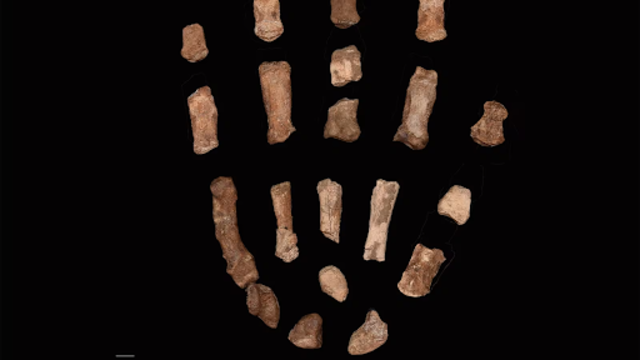
The long thumb and straight fingers of Paranthropus boisei suggest it could grip objects firmly, much like how people hold a hammer today. However, the wide finger bones show similarities to a gorilla’s hand, revealing a surprising mix of human-like strength and ape-like traits. (CNN Newsource)
Scientists have uncovered the first known hand fossils of Paranthropus boisei, an extinct human relative that lived more than a million years ago. The discovery, made in Kenya’s Koobi Fora region near Lake Turkana, shows the species had a surprisingly strong and dexterous hand — capable of both powerful grips and precise movements.
The fossils, found alongside skull and teeth remains, date back 1.52 million years. They give researchers their first real look at what this species’ hands looked like and how they might have used them.
“Nutcracker Man” Reveals Unexpected Abilities
Paranthropus boisei, often nicknamed “Nutcracker Man” because of its large teeth and powerful jaws, was known only through skull fossils until now. The species’ molars were about four times larger than those of modern humans, suggesting it ate tough plant foods.
The newly discovered hand bones include a long thumb, straight fingers, and a flexible pinky, all pointing to a strong grasp, similar to how humans hold a tool or hammer. However, the finger bones were broad and curved like those of a gorilla, which surprised researchers.
“This is the first time we can confidently link Paranthropus boisei to specific hand and foot bones,” said Carrie Mongle, a paleoanthropologist at Stony Brook University and lead author of the study published in Nature.
Tracy Kivell of the Max Planck Institute for Evolutionary Anthropology called the find “unexpected,” adding, “It is clearly the hand of a human ancestor but has features that are remarkably similar to gorillas.”
Rethinking Early Tool Use
The discovery also challenges long-held beliefs about who could make and use stone tools. Until recently, experts thought only members of the Homo genus — such as Homo habilis and Homo erectus — had that ability.
But P. boisei lived in eastern Africa between 1.3 and 2.6 million years ago, overlapping with those early humans. Fossils and stone artifacts found in Kenya suggest that tool use may have been common across several ancient species.
Mongle noted that the hand’s structure would have allowed P. boisei to handle tools efficiently. “There is nothing in its hand anatomy that would prevent tool use,” she said.
However, experts remain cautious. “We may never know for sure who was making these tools,” said Ryan McRae of the Smithsonian National Museum of Natural History, “but this discovery brings Paranthropus closer to that picture than ever before.”
A Climber and a Walker
The fossils also included foot bones showing arched feet, which helped P. boisei walk upright. Its strong hands suggest it could still climb or handle tough plants, giving it a mix of abilities suited to both ground and limited tree life.
According to McRae, P. boisei likely used its hands to strip or prepare fibrous plants rather than for climbing.
A Family Legacy of Discovery
The fossils were unearthed between 2019 and 2021 by a team led by Louise Leakey, granddaughter of the legendary paleoanthropologists Louis and Mary Leakey, who first identified P. boisei in the 1950s in Tanzania.
Those earlier finds revealed a species adapted to a diet of roots and grasses. Now, with the addition of these hand fossils, scientists can better understand how P. boisei lived, moved, and interacted with its environment — offering a fresh look at how diverse our ancient relatives truly were.