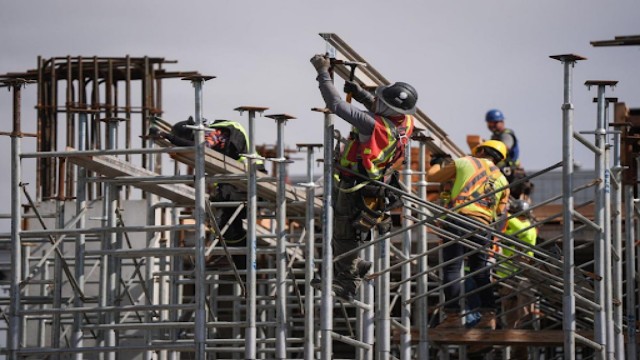
Construction workers are seen on the job at a condo project in Delta, B.C., on Wednesday, July 2, 2025. Half a year after Donald Trump returned to the U.S. presidency, builders say they’re still facing uncertainty when it comes to getting building materials on time and at a steady cost. THE CANADIAN PRESS/Darryl Dyck
Canada's homebuilding sector is navigating a rough road this year, facing soaring material prices and a rocky supply chain—thanks largely to the ongoing trade war. As blanket tariffs and specific material levies hit the market, builders across the country are struggling to stay on track.
Earlier this year, the reintroduction of U.S. tariffs under President Trump sparked uncertainty for Canadian industries. For homebuilders, that meant adjusting timelines, switching suppliers, and absorbing costs they didn’t see coming.
Cheryl Shindruk, Executive VP of Geranium Homes in Ontario, said the impact is real. While it’s hard to assign a direct dollar figure to the changes, she noted that disruptions in material availability and delivery timelines are becoming routine.
To adapt, Geranium has shifted to sourcing more materials within Canada—like bricks and stones—and exploring alternatives outside the U.S., such as steel from South Korea, Portugal, and China. Still, some key materials, like patented window glass components, are only available from the U.S., forcing builders to pay the added tariffs.
“You can’t flip a switch and start making everything locally overnight,” Shindruk said. “Some materials just have no domestic alternatives.”
Other commonly used items—like appliances, carpets, and doors—have also been hit by trade penalties. Builders are swapping carpets for vinyl planks or stockpiling materials to avoid future delays. But these strategies bring new challenges, like higher overheads and storage issues.
At Altree Developments in the Greater Toronto Area, the expected cost increase due to tariffs was initially estimated at 3% to 5% of the company’s budget. According to CEO Zev Mandelbaum, that number has since dropped thanks to the greater availability of Canadian-made materials. However, he says the bigger issue now is unpredictability. With tariffs fluctuating and trade talks constantly shifting, long-term planning has become nearly impossible.
And the economic instability brought on by the trade war has also affected homebuyers. Fewer people are investing in new homes—locals and international buyers alike—which has hit builders' revenues even harder than the tariffs themselves.
“Fear of economic instability is pushing people away from the market,” said Mandelbaum. “And that’s making it harder to manage construction costs.”
In February, the Canada Mortgage and Housing Corporation (CMHC) warned that trade tensions, combined with reduced immigration targets, could slow down the housing sector. That prediction is now playing out in real time.
So far in 2025, housing starts in areas with populations over 10,000 are up 4% compared to the same period in 2024. But a closer look shows cracks in the surface. In Ontario, housing starts have dropped by 26%. In British Columbia, they’re down 8%. These regions, heavily impacted by tariffs, are also seeing a rise in mortgage arrears, pointing to job losses and deeper economic strain.
CMHC’s chief economist, Mathieu Laberge, expects these problems will reduce future home construction even further. “It’s already showing in some places, even if the national numbers don’t reflect it yet,” he said.
The Canadian Home Builders’ Association shares the same concerns. According to CEO Kevin Lee, housing starts across the country aren’t keeping up with demand. Before tariffs, places like Atlantic Canada and the Prairies were beginning to bounce back from a slowdown caused by high interest rates. But now, even those improvements are fading.
“Ontario and B.C. were already struggling due to high prices,” Lee said. “Now things are getting worse everywhere.”
In a recent industry survey, 87% of builders expressed concern about the future of their businesses. Alarmingly, 35% admitted they had laid off workers and had no plans to rehire—up sharply from 21% last year.
“This is no longer a short-term bump,” Lee said. “The market is under real pressure, and it’s only getting more serious.”