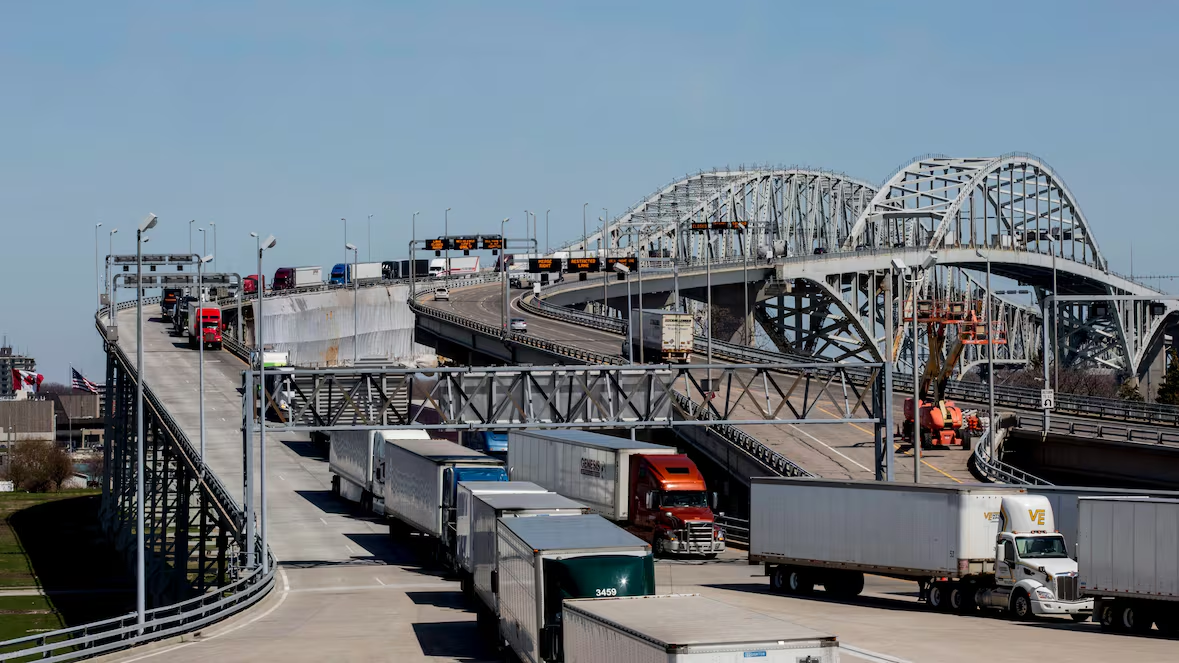
Commercial trucks travel across the Blue Water Bridge in Sarnia, Ontario, which has now become the busiest trade crossing between Canada and the United States, surpassing Windsor. The Associated Press
A major change has taken place in trade between Canada and the United States. The Blue Water Bridge has now become the busiest commercial crossing, moving ahead of the long-dominant Ambassador Bridge.
This shift marks the first time in decades that the Windsor-Detroit route no longer leads in commercial traffic. Officials say higher toll costs at the Ambassador Bridge have pushed many trucking companies to choose the Sarnia route instead.
Truck Traffic Numbers Tell the Story
Recent figures show a clear change in traffic patterns. In 2025, about 2.1 million commercial trucks crossed at Sarnia, compared with roughly 1.9 million at Windsor.
The trend has continued into 2026. During the first three months of the year, the Blue Water Bridge handled over 531,000 truck trips, while the Ambassador Bridge saw just under 497,000.
Officials confirmed the shift in traffic. "The Blue Water Bridge has surpassed all other international crossings in commercial traffic volume," said Alexandre Gauthier of the Federal Bridge Corporation Limited.
Toll Costs Drive Decisions
Higher toll rates at the Ambassador Bridge have played a major role in this change. Truck operators pay up to $27 per axle at Windsor, while rates at Sarnia remain much lower at about $7 per axle.
This difference has encouraged companies to reroute their shipments. Industry leaders say cost has become a key factor in planning routes.
Stephen Laskowski, head of the Canadian Trucking Alliance, explained the shift. "Price sensitivity entered in the market for the supply chain," he said.
He also noted that the Ambassador Bridge had long been the busiest crossing by a wide margin. The recent change shows how quickly traffic can move when costs rise.
Delays Add Pressure
The ongoing delay of the Gordie Howe International Bridge has added to the situation. This new crossing aims to ease congestion in the Windsor-Detroit area, but it has not yet opened.
Officials had expected the project to open earlier, but delays and rising costs have slowed progress. The total cost has now reached about $6.1 billion, well above the original estimate.
Experts say these delays have real consequences. Some estimates suggest the late opening could cost millions of dollars each week in lost trade efficiency.
Questions Around Project Costs
The project has also raised concerns about how large infrastructure plans are managed. Some experts believe earlier promises about keeping costs and timelines under control did not hold up.
Matti Siemiatycki, a professor at the University of Toronto, said governments often take on the burden when problems arise, even when private partners are involved.
He pointed out that risks cannot always be fully passed on, especially during unexpected events.
A Changing Trade Landscape
The shift from Windsor to Sarnia shows how quickly trade routes can change when costs and delays come into play. For now, the Blue Water Bridge continues to handle the highest volume of commercial traffic between the two countries.
Officials and industry leaders will watch closely to see how future changes, including the opening of the new bridge, affect these patterns.