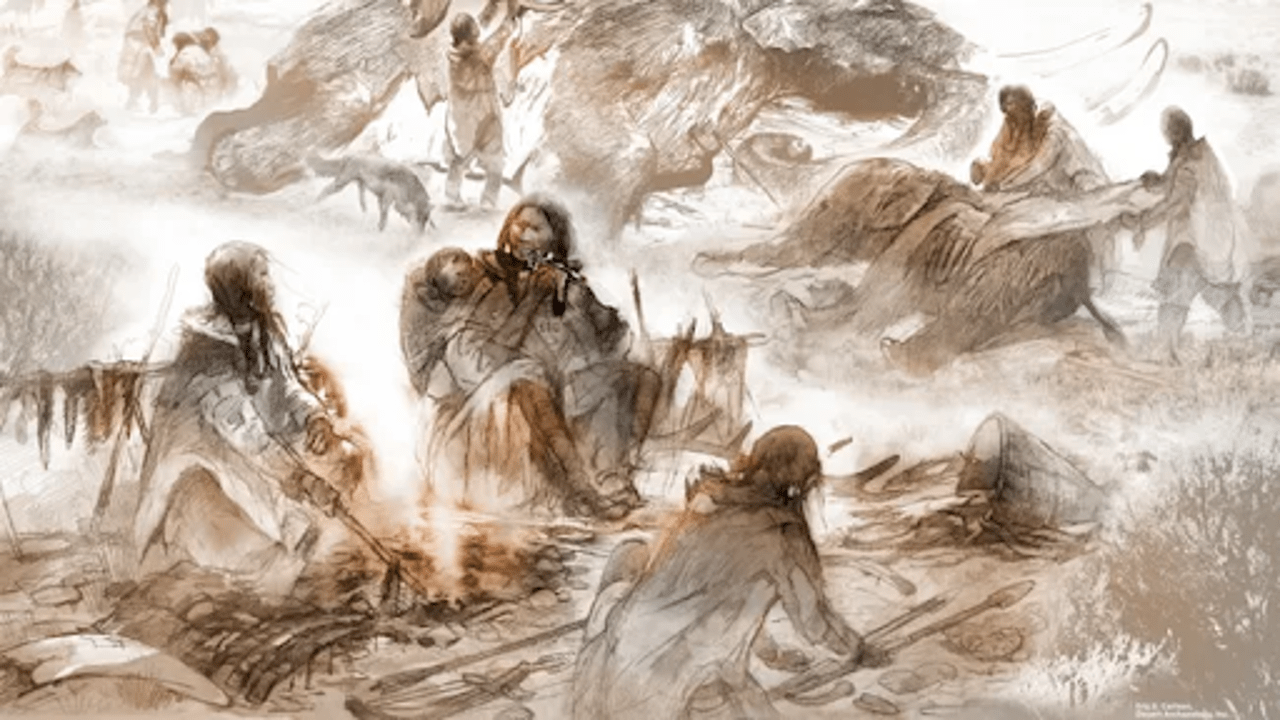
This artwork imagines life for a Clovis family around 12,800 years ago, featuring an infant named Anzick-1 and his mother eating mammoth meat by a fire. The image was created through a collaboration between artist Eric Carlson and archaeologists Ben Potter and Jim Chatters. Live Science
A new study offers a fascinating glimpse into the diets of early Indigenous Americans, revealing that mammoths played a central role in their survival. The research focuses on an 18-month-old boy, named Anzick-1, who lived nearly 13,000 years ago in what is now Montana. His bones provided key insights into the eating habits of his family group and the broader Western Clovis culture, to which he belonged.
Researchers used chemical analysis to examine the boy's bones and reconstruct the diet of his mother. They focused on stable radioisotopes—atoms with a different number of neutrons—which can offer detailed information about what a person ate. In Anzick-1’s case, the isotopic analysis suggested that his mother’s diet closely resembled that of the scimitar cat, an animal known to specialize in hunting mammoths.
This finding is significant because it challenges previous ideas that the Clovis people primarily hunted smaller animals like bison or elk. Instead, it shows that mammoths were a major food source for the Clovis, along with other large animals such as bison and elk. The research indicates that the Western Clovis culture’s reliance on mammoth meat helped them thrive and spread across North America. This marks a shift in how researchers view the diet of early humans in the Americas. The study's lead author, James Chatters, an archaeologist and paleontologist at McMaster University, explained that mammoths provided a dependable source of fat and protein, which helped the Clovis people expand their territory quickly. He noted that hunting these large animals likely played a crucial role in the mobility and success of the Clovis, allowing them to migrate across vast distances in search of food and new resources.
Ben Potter, co-lead author and archaeologist at the University of Alaska Fairbanks, further emphasized the flexibility of the Clovis people’s lifestyle. He stated that their focus on mammoth hunting meant they didn’t need to rely on smaller animals, which could vary from region to region. This adaptability was crucial for their migration and settlement patterns.
The study also examined the dietary patterns of the boy’s mother by adjusting the isotopic data for nursing, showing that about 40% of her diet consisted of mammoth meat, with the rest coming from other large animals. This evidence adds weight to the theory that mammoths were central to the Clovis diet, rather than smaller game, which had been thought to play a more significant role.
The findings are also thought to explain the rapid spread of the Clovis people across North and South America. With mammoths providing a steady food source, they could focus on larger hunting expeditions rather than chasing smaller, unpredictable animals. Interestingly, the researchers suggest that the Clovis people’s preference for mammoth meat could have contributed to the eventual extinction of these giant creatures toward the end of the last ice age.
Overall, the study paints a vivid picture of early human survival, highlighting the importance of mammoth hunting in the Clovis culture. It’s a powerful reminder of how these early societies adapted to their environment, using their knowledge and skills to thrive in a challenging world.