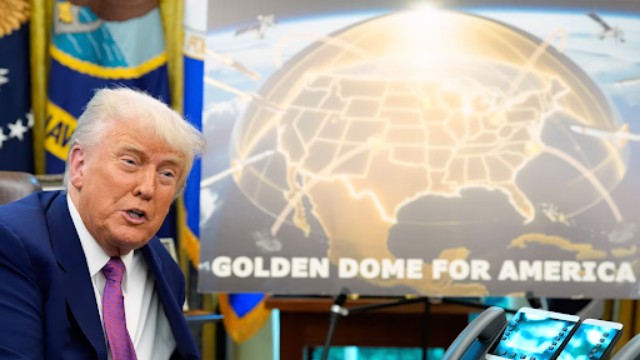
U.S. President Donald Trump addresses the media from the Oval Office at the White House in Washington. (AP Photo/Alex Brandon)
The U.S. government is shifting gears on its ambitious space-based missile defense project, the Golden Dome. Originally reliant on Elon Musk’s SpaceX, the Trump administration is now actively reaching out to other players like Amazon’s Project Kuiper and top defense firms. This move comes amid rising tensions between Trump and Musk, whose falling out on June 5 has sent ripples through the defense tech community.
Even before their clash turned public, officials had already begun exploring options beyond SpaceX. Concerns were mounting over putting all their eggs in one basket, especially with a program that carries a staggering $175 billion price tag. Two sources confirmed that both the Pentagon and White House were quietly diversifying their potential vendor pool.
While SpaceX remains a strong contender thanks to its track record—having launched over 9,000 Starlink satellites—it’s clear the dominance it once enjoyed may be tapering off. Musk, responding to the report on social platform X, stressed that federal contracts must go to the “best provider at the best price,” warning against favoritism.
Amazon’s Project Kuiper, although still in early stages with only 78 satellites launched out of 3,000 planned, is drawing serious interest. Pentagon officials reportedly approached Kuiper directly, signaling a willingness to incorporate commercial tech players into the national defense mix. Jeff Bezos, Amazon’s chairman, previously admitted that Kuiper, while commercial at heart, would likely serve defense roles.
The Golden Dome is inspired by Israel’s Iron Dome but is planned to be a far larger, layered network of satellites capable of covering vast territories. For this, more suppliers are necessary. “Kuiper is a big one,” one official said, referring to the project’s potential role in satellite layering.
Though SpaceX may still lead major launches, newer space startups like Rocket Lab and Stoke Space are gaining attention. Officials plan to open up launch bids to a wider range of vendors over time, rather than automatically defaulting to SpaceX.
Urgency Grows as Satellite Demand Surges
There’s an immediate need for more satellites. In response, Congress boosted Space Force’s satellite budget from $900 million to $13 billion last year. This surge aims to accelerate private sector production for critical communication and missile-tracking networks.
Project Kuiper—originally staffed by former Starlink engineers fired by Musk—is under renewed evaluation. It might not yet rival Starlink’s scale, but its potential for defense use is attracting fresh attention, especially as the government preps to allocate the first $25 billion chunk from Trump’s major spending initiative.
Legacy defense contractors such as Northrop Grumman, Lockheed Martin, and L3Harris are also vying for a spot in the project. L3Harris reports increased interest in its missile-tracking tech, while Northrop is working on a space-based interceptor. Lockheed Martin has also voiced readiness to contribute.
Smaller Firms, Bigger Opportunities
The administration had initially invited Silicon Valley startups to the table, viewing them as agile, affordable alternatives to traditional contractors. Firms like Palantir and Anduril, both with close ties to Trump, were early favorites. However, Trump’s souring relationship with Musk has reshaped the competitive field, opening the door to even more players.
Musk has since launched a centrist political group called the “America Party,” opposing Trump’s high-spending strategies. This political rift could influence which companies ultimately win contracts.
Fast Track Timeline Raises Pressure
Trump wasted no time launching Golden Dome during his second term. General Michael Guetlein, confirmed by the Senate on July 17, has been tapped to lead the charge. Under orders from Defense Secretary Pete Hegseth, he must form a team within 30 days, provide a working design in 60, and deliver a full plan—including satellite and ground station details—within 120 days.
Shortly after Reuters broke the news, the Pentagon issued a press release confirming that Golden Dome’s system design will be ready within 60 days.
Security Challenges & Strategic Stakes
The inclusion of commercial satellites introduces serious cybersecurity challenges. Kuiper, like SpaceX’s Starlink, will need protection from jamming and cyberattacks. Musk has previously noted SpaceX spends heavily defending Starlink against Russian interference.
Beyond technical hurdles, the Golden Dome’s success could redefine global security. If fully deployed, the shield might push adversaries to develop new weapons or further militarize space.
Despite the changes, major players like Lockheed and RTX (formerly Raytheon) are expected to stay at the forefront. RTX, which manufactures the Patriot missile system, believes Golden Dome will reshape missile defense within the next 2–3 years.