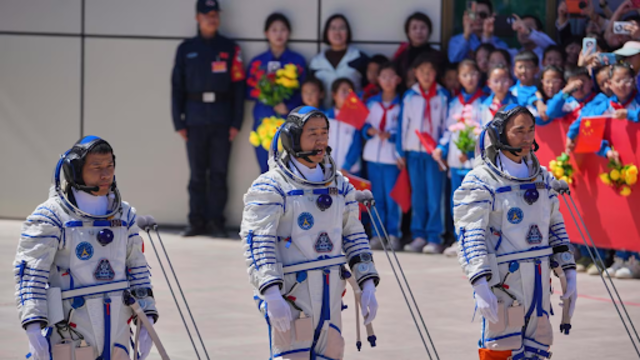
Chinese astronaut Chen Dong, centre, joined crewmates Chen Zhongrui, right, and Wang Jie at a send-off ceremony for the Shenzhou-20 mission held at the Jiuquan Satellite Launch Center in northwestern China on April 24, 2025. AP Photo
China’s three astronauts aboard the Shenzhou-20 spacecraft remain safe and in good spirits after their planned return to Earth was delayed due to space debris concerns. The country’s Manned Space Engineering Office confirmed Tuesday that the crew members are “in good condition, working and living normally.”
The astronauts were originally scheduled to return on November 5, but the plan changed after their spacecraft was believed to have been hit by a small fragment of space debris. Officials postponed the return to ensure safety, though they have not announced a new landing date.
Space Debris Forces Delay
The mission control team continues to monitor the situation closely. Engineers are conducting checks, simulations, and safety drills to make sure the Shenzhou-20 capsule can return safely to Earth.
“The Shenzhou-20 crew is in good condition, working and living normally,” the agency said in its official statement.
The three astronauts — Chen Dong, Chen Zhongrui, and Wang Jie — have been aboard the Tiangong space station since April. They were completing a six-month rotation before the debris incident forced an unexpected extension of their stay.
Officials say the crew has ample supplies and continues to follow its daily work schedule. The astronauts remain focused on maintenance tasks and ongoing scientific research aboard the space station.
Replacement Mission Successfully Arrived
While the Shenzhou-20 crew waits for clearance to return, China’s space program continues its work in orbit. The replacement mission, Shenzhou-21, successfully docked with the Tiangong station on November 1.
This latest mission brought a new group of astronauts as well as several scientific experiments — including a set of mice for biological research. It marks the first time China has sent live animals to its space station for long-term study.
The arrival of Shenzhou-21 ensures that the station remains fully staffed and operational, even as mission control prepares for the Shenzhou-20 crew’s eventual return.
China’s Expanding Space Ambitions
China’s space program has advanced rapidly in recent years. Since launching its first astronaut in 2003, the country has built the Tiangong space station, conducted multiple crewed missions, and developed the ability to carry out complex spacewalks and experiments.
The government has also set an ambitious target of landing astronauts on the moon by 2030. The success of ongoing missions like Shenzhou-20 and Shenzhou-21 helps lay the groundwork for future lunar exploration.
Despite the recent delay, officials say the crew’s safety remains the top priority. Space debris has become an increasing concern for all spacefaring nations as thousands of fragments orbit the Earth, posing a potential threat to satellites and spacecraft.
China’s engineers continue to assess the situation before scheduling a new return date for the Shenzhou-20 mission.