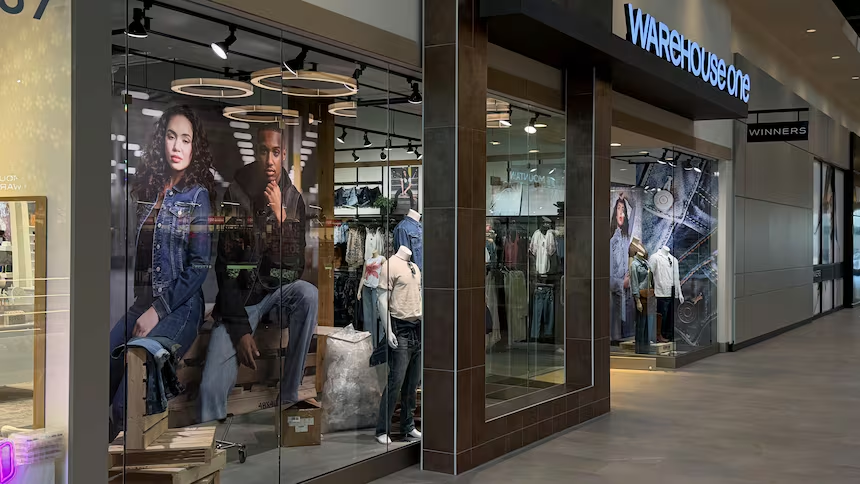
Warehouse One posted a net loss of about $15 million in its last fiscal year, after a $6.5-million loss the year prior. It's liquidating stores like this one in a Winnipeg mall.
Winnipeg-based retailer Warehouse One is preparing to liquidate all 128 of its stores across Canada, including locations operating under the Bootlegger brand, after filing for court protection amid mounting financial struggles.
The company, which has been a familiar name in Canadian retail since 1977, said it could no longer meet critical financial obligations, including employee wages and rent payments, without legal protection under the Companies’ Creditors Arrangement Act.
The decision marks another significant blow to Canada’s traditional retail landscape, as shifting consumer habits and rising competition continue reshaping the industry.
Warehouse One Liquidation Follows Deep Financial Losses
Court filings revealed the retailer was facing what company leadership described as an “acute liquidity crisis.” Executives pointed to declining mall traffic, growing competition from fast-fashion retailers, and the rapid rise of online shopping platforms as major contributors to the company’s collapse.
Warehouse One recorded losses of roughly $21.5 million over the past two fiscal years, including a $15 million loss in its latest reporting period. The company also carried millions of dollars in debt owed to lenders, suppliers, and affiliated entities.
The acquisition of casual clothing chain Bootlegger added further financial pressure. While the purchase increased revenue, rising operating costs largely erased those gains, leaving the business in a weaker position overall.
Small-Town Canada Hit Hardest by Closures
The Warehouse One liquidation is expected to affect communities across eight provinces and the Yukon, with many smaller towns facing limited retail alternatives.
About one-third of the retailer’s footprint operated in smaller Canadian communities, where the brand had built a loyal customer base over decades. However, sales in those markets declined sharply as populations aged, shopping habits shifted online, and economic uncertainty changed spending patterns.
For many customers, the closures represent more than the loss of a clothing store. Residents in smaller communities say affordable and accessible shopping options are already limited, making the shutdown especially difficult.
Customers who relied on nearby Warehouse One locations may now need to shop online or travel long distances to larger cities for similar products.
Changing Consumer Habits Reshape Retail Industry
Retail analysts say the company’s downfall reflects broader changes across the Canadian retail market. Consumers facing inflation and financial uncertainty are increasingly choosing either low-cost discount retailers or premium luxury brands, leaving mid-tier mall retailers struggling to compete.
Discount chains and resale platforms have seen steady growth in recent years, while traditional mall-based stores continue losing relevance. Industry experts note that shoppers are becoming more selective, often prioritizing value and convenience over brand loyalty.
This shift has also affected shopping malls themselves, with many once-popular retail centres losing major tenants and attracting fewer visitors.
As more mid-range retailers disappear, online giants continue expanding their reach, particularly in communities where local shopping options are shrinking.
Hundreds of Employees Face Uncertainty
The company employs 982 people nationwide, including more than 230 workers in Manitoba. None of the employees are unionized, and over 400 work full-time positions.
The liquidation process now places hundreds of jobs at risk, adding further concern for communities already dealing with retail contraction.
Despite the financial collapse, the court approved a temporary extension allowing customers to redeem gift cards until May 13. The company also continues operating its Winnipeg-based distribution centre during the restructuring process.
Pandemic Aftereffects Continue to Linger
Warehouse One had previously recovered from an earlier receivership in 2002 and remained profitable for many years afterward. However, company officials said the business never fully regained stability following the COVID-19 pandemic.
The combination of changing consumer behavior, rising operational costs, and intensifying online competition ultimately proved too difficult to overcome.
As the Warehouse One liquidation moves forward, the retailer’s decline highlights the growing challenges facing Canada’s mid-tier retail sector in an increasingly digital and price-sensitive market.