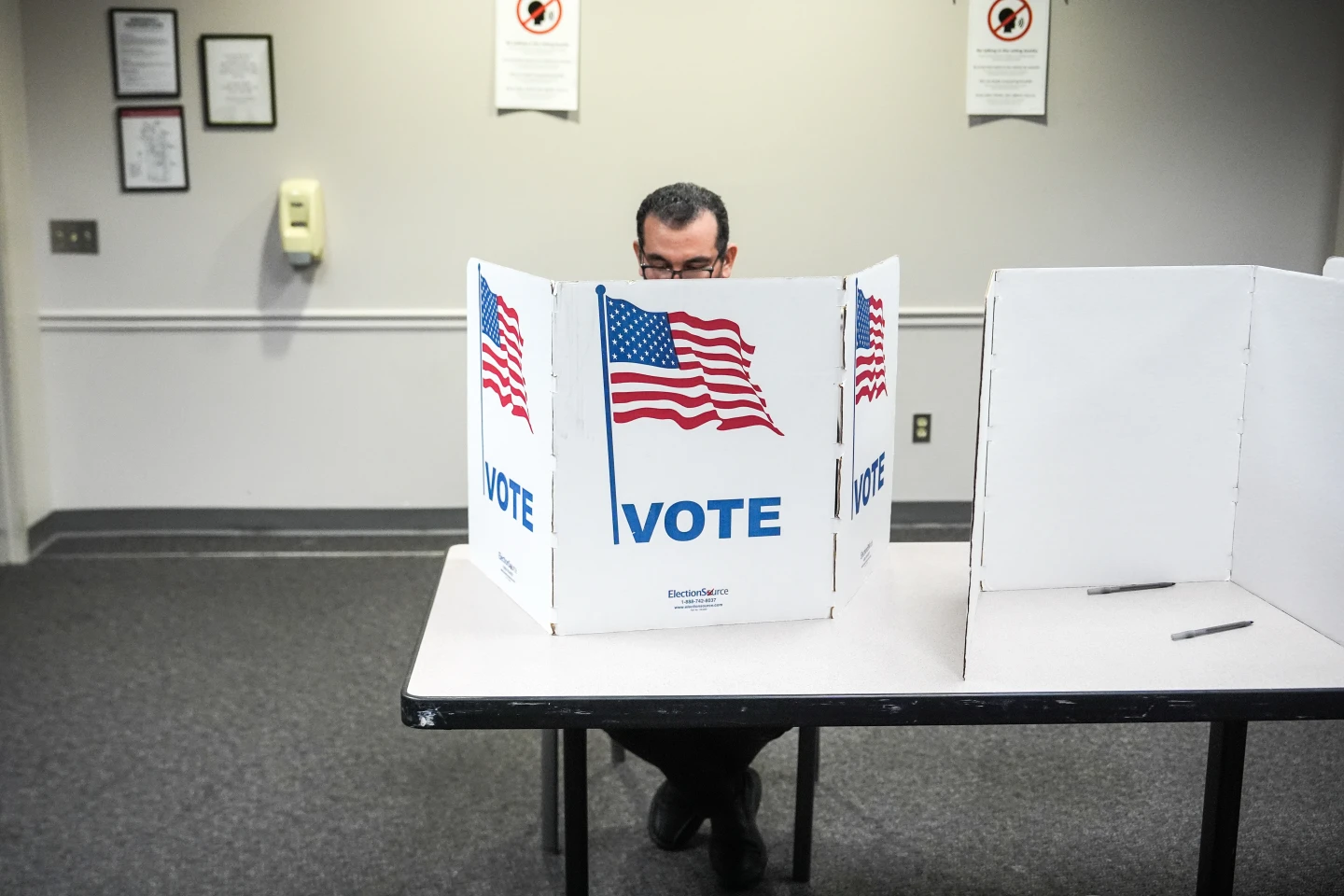
A Person votes in the Virginia redistricting referendum at Fairfax Government Center, Tuesday, April 21, 2026.
The Virginia Supreme Court delivered a significant political victory to Republicans on Friday by overturning a voter-approved congressional redistricting plan backed by Democrats. The ruling adds fresh momentum to the national battle over congressional maps ahead of the upcoming midterm elections, where control of the U.S. House remains fiercely contested.
In a narrow 4-3 decision, the court concluded that Virginia lawmakers failed to follow constitutional procedures when placing the redistricting amendment before voters. Although the measure had narrowly passed in a statewide referendum earlier this year, the court ruled that the process leading to that vote violated the state constitution, effectively nullifying the result.
The decision immediately reshaped the political landscape in Virginia, where Democrats had hoped the revised congressional boundaries would help them gain several additional House seats.
Virginia Supreme Court Focuses on Constitutional Process
Rather than examining the fairness of the congressional districts themselves, the case centered on how the constitutional amendment reached the ballot. Under Virginia law, constitutional amendments require legislative approval during two separate sessions, with a statewide election occurring in between.
The dispute arose because lawmakers approved the amendment during a period when early voting for the general election had already begun. Attorneys challenging the plan argued that this timing breached constitutional requirements because voters were already casting ballots before the amendment received initial approval.
The court agreed with that interpretation, stating that the legislature acted too late in the election process. According to the ruling, millions of Virginians had already begun voting by the time lawmakers advanced the amendment, undermining the integrity of the referendum process.
Chief Justice Cleo Powell disagreed in her dissent, arguing that the legal definition of an election should apply only to Election Day itself rather than the broader early voting period.
Redistricting Battle Intensifies Before Midterms
The Virginia Supreme Court ruling arrives during a broader national fight over congressional redistricting. Both parties have aggressively pursued favorable maps as they seek an advantage in closely contested House races.
Democrats viewed Virginia’s proposed map as a chance to offset Republican-led redistricting efforts in states such as Texas, Florida, and North Carolina. Under the blocked proposal, Democrats believed they could improve their chances in nearly all of Virginia’s 11 congressional districts.
Several revised districts would have strengthened Democratic influence in northern Virginia, Richmond, Hampton Roads, and parts of western Virginia. Republican voters in some conservative areas would have been distributed across multiple districts, reducing their electoral impact.
The court majority criticized the proposed map’s political imbalance, noting that Republican candidates won nearly half of Virginia’s congressional vote in 2024 while the new map could have resulted in Democrats controlling almost all House seats from the state.
Republicans Celebrate as Democrats Prepare Appeal
Republican leaders quickly celebrated the outcome, describing it as another indication of strong momentum heading into the midterm elections. Former President Donald Trump praised the ruling publicly, while GOP congressional leaders framed it as a major win for election fairness.
Democrats, meanwhile, argued that the court ignored the will of voters who had approved the amendment. Party leaders announced plans to pursue an emergency appeal before the U.S. Supreme Court, although legal experts consider the effort unlikely to succeed.
Historically, the nation’s highest court has shown reluctance to overturn state supreme court interpretations of state constitutions, especially in election-related cases.
National Redistricting Debate Continues
The Virginia case reflects a growing trend of mid-decade redistricting battles rarely seen in modern American politics. Traditionally, congressional maps are redrawn once every decade following the census. However, recent political pressure has prompted several states to revisit district boundaries sooner.
At the same time, a recent U.S. Supreme Court decision weakening portions of the Voting Rights Act has encouraged further redistricting efforts across multiple Republican-led states.
With the midterm elections approaching rapidly, the fight over congressional maps is likely to remain one of the defining political battles of the year. Virginia’s ruling now stands as one of the most consequential decisions in that ongoing national struggle.