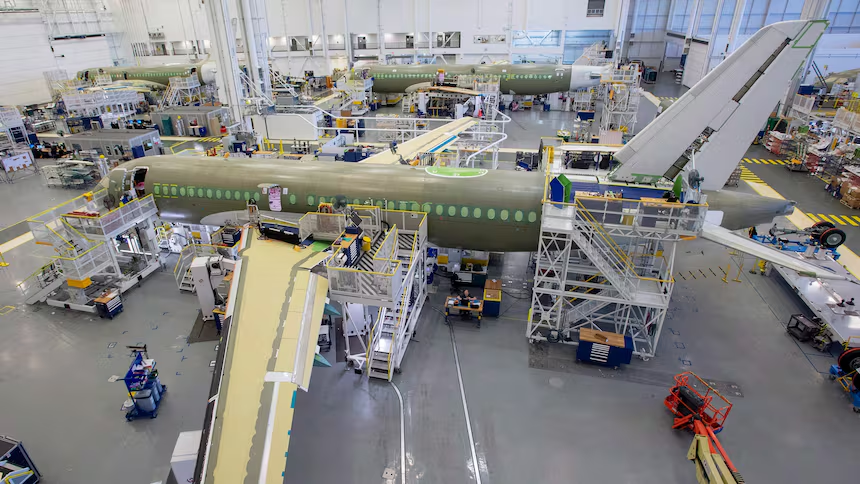
The Airbus A220 assembly line is seen at the company's facility Jan. 14, 2019 in Mirabel, Quebec.
Airbus Canada has secured a landmark agreement with Malaysian low-cost carrier AirAsia, signing a record-breaking order for 150 A220 aircraft in a deal expected to significantly strengthen Quebec’s aerospace industry. The agreement represents the largest single firm purchase of A220 jets since the aircraft program was launched, highlighting growing international demand for the Canadian-assembled plane.
The aircraft will be built at Airbus’s Mirabel facility near Montreal, where production of the A220 has become a central pillar of Quebec’s aviation sector. Deliveries are scheduled to begin in early 2028, according to AirAsia CEO Tony Fernandes, who described the purchase as a strategic investment despite ongoing global economic uncertainty.
Airbus AirAsia Deal Reinforces Quebec’s Aviation Importance
The Airbus AirAsia deal arrives at a time when governments and industry leaders are seeking to strengthen trade relationships beyond North America. Prime Minister Mark Carney used the announcement to emphasize Canada’s efforts to deepen economic ties with Southeast Asia, calling the agreement an example of international cooperation during a challenging global climate.
Speaking at the Mirabel plant, Carney praised the confidence AirAsia has shown in Canadian manufacturing and Quebec workers. He said partnerships like this demonstrate the value of open economies and long-term industrial investment, particularly during periods of global instability.
For Airbus executives, the agreement also reflects the transformation of the former Bombardier CSeries program into a globally competitive aircraft platform. Airbus acquired a majority stake in the struggling program in 2018 and later rebranded the aircraft as the A220.
Production Goals and Industry Challenges
While the historic order marks a major commercial victory, Airbus still faces ongoing production challenges at its Quebec operations. Supply chain disruptions over recent years have slowed manufacturing, with shortages affecting critical components including engines and wings.
Currently, Airbus has been producing just over seven A220 aircraft per month on average, a level still below profitability targets. Company officials say the objective is to raise production to 13 aircraft monthly by early 2028, around the same time AirAsia’s first deliveries begin.
Airbus Canada CEO Guillaume Chevasson acknowledged the program remains short of profitability but stressed that expansion plans are moving forward steadily. He confirmed that all 150 aircraft included in the AirAsia agreement will be assembled in Mirabel.
The facility has expanded significantly in recent years, adding roughly 2,500 workers over the past four years and bringing total employment to nearly 5,000.
Workers and Government Welcome the Agreement
Industry groups and labour representatives quickly welcomed the Airbus AirAsia deal, describing it as a major win for Quebec’s workforce. Aerospace unions noted that large international contracts not only support manufacturing jobs but also bring long-term economic benefits to the province.
Experts also pointed out the unusual timing of the purchase, as many airlines worldwide remain cautious because of geopolitical tensions and rising fuel prices. Ongoing instability in the Middle East has increased operational costs for carriers, leading several airlines to reduce flight schedules instead of expanding fleets.
Fernandes addressed those concerns directly, arguing that periods of uncertainty often create opportunities for companies willing to invest aggressively. He said global crises eventually pass, while long-term aviation demand continues to grow.
Financial Stakes Remain High
Despite the celebration surrounding the agreement, financial risks still linger for governments involved in the A220 program. Quebec previously invested heavily in the former CSeries project and later reduced the estimated value of some of those investments.
Still, aviation analysts believe the latest order provides renewed momentum for Airbus Canada and reinforces the importance of the A220 in the competitive narrow-body aircraft market.
The A220-300, designed for medium-range routes, can carry between 100 and 160 passengers and fly distances of up to 6,700 kilometres. With more than 500 aircraft already delivered worldwide, the model continues to attract airlines seeking fuel-efficient and flexible fleet options.
For Quebec’s aerospace industry, the Airbus AirAsia deal represents more than a commercial success. It signals renewed confidence in Canadian aviation manufacturing at a time when global competition remains intense.