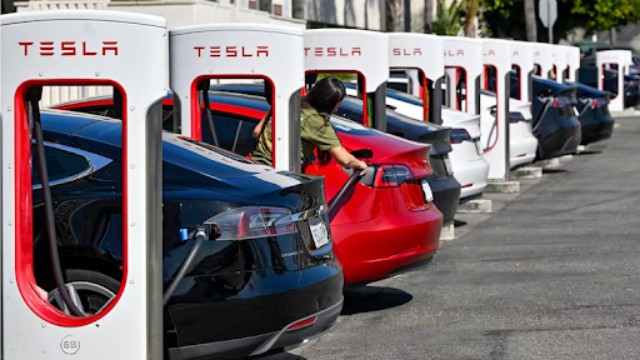
Tesla owners plugged in their cars to charge in Santa Ana, California (Photo: Jeff Gritchen, The Orange County Register/AP)
Tesla's sales have taken a sharp downturn for the second consecutive year, with a 13% drop in deliveries from April to June 2025 compared to the same period last year. The electric carmaker sold 384,122 vehicles in this quarter, down from 443,956. With just six months left in the year, Tesla must sell over a million vehicles to avoid another annual decline.
The road ahead isn’t easy. Economic uncertainty, new tariffs, and potential changes to federal EV tax credits under former President Donald Trump’s proposed tax policies have clouded Tesla’s future. One major threat: the possible end of a $7,500 federal tax credit for new EV buyers—a perk that has long driven Tesla sales.
Adding to the challenges, Tesla CEO Elon Musk is facing political backlash. Demonstrations against Musk’s political ties and public comments began in March and continue to flare up across Tesla showrooms worldwide. Though Musk has claimed Tesla is rebounding, the data paints a mixed picture.
Still, not all signs are negative. Tesla’s core models—the Model 3 and Model Y—did better than expected, with 373,728 units sold, beating analyst predictions of 356,000. That slight silver lining pushed Tesla’s stock up by 4.6% in afternoon trading. Seth Goldstein from Morningstar noted that while the results weren’t as grim as feared, Tesla’s current car lineup has likely hit its peak.
Analysts agree that the company needs fresh, affordable models to attract new buyers and increase delivery numbers. Tesla has hinted at a new budget-friendly version of the Model Y, but reports suggest its production has been delayed beyond the promised June launch.
Sandeep Rao, an analyst at Leverage Shares, sees a glimmer of hope. He points out that although deliveries are still down compared to last year, the decline is slowing, possibly indicating a turnaround in the second half of 2025.
Tesla has been trying to spark interest with low-interest financing and other offers, but newer, more advanced models from Chinese competitors are luring customers away—especially in Europe. In May, Tesla’s sales in 30 European countries dropped 28%, even as the continent saw a surge in EV sales overall. China’s BYD is one of the key players eating into Tesla’s market share.
Meanwhile, Musk’s feud with Donald Trump could hurt business even more. After Musk publicly criticized Trump’s latest budget plans, the former president threatened to target Tesla through executive power, leading to a 5% drop in the company’s stock price.
On top of this, Tesla seems to be shifting focus away from new car models toward developing self-driving tech and robotaxis. A pilot robotaxi project is already underway in Austin, Texas, but has caught the attention of federal safety regulators due to several incidents—one of which showed a Tesla driving into an oncoming lane.
Musk himself admitted that his political activities and role in government reforms have dented Tesla’s image. However, he believes many customers are simply waiting for the revamped Model Y before making their next purchase.
Investors and customers alike will be watching closely on July 23, when Tesla is set to release its second-quarter financial report. After a staggering 71% drop in net income during the first quarter, the upcoming figures will be key in determining whether Tesla can climb out of its slump—or fall even further behind.