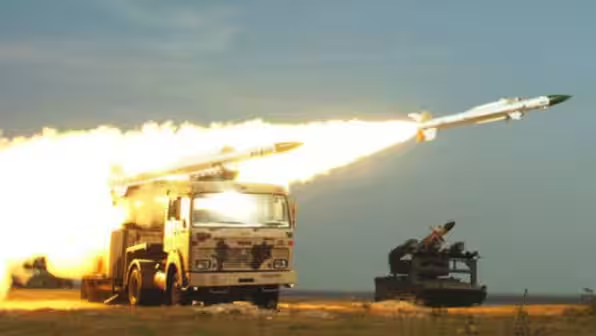
The photograph shows Akash medium-range surface-to-air air defence missile system in action. (Photo: Bharat Electronics Limited)
John Spencer, a U.S. military expert, recently assessed India’s strategic success in Operation Sindoor, highlighting its swift rise to air superiority in just 72 hours and the failure of Pakistan’s operations after the initial setbacks. Despite initial tactical gains by Pakistan, India quickly gained control of the skies.
Tactical Overview
The conflict, which began on the night of May 6-7, saw India target terrorist sites in Pakistan and Pakistan-occupied Jammu and Kashmir (POJK). This was met with Pakistan’s counterattacks on Indian cities and military sites, but India’s responses, including strikes on Pakistani airbases, air defense systems, and military facilities, ultimately tipped the scales.
Strategic Air Defense Tactics
India’s systematic suppression of Pakistan’s air defense network—targeting early-warning radars and surface-to-air missile systems—greatly degraded Pakistan’s ability to respond. Notably, India's air superiority was cemented by the use of advanced loitering munitions and integrated air defense systems like the Integrated Air Command Control and Communication System (IACCCS).
Pakistan’s Early Success and Strategic Shift
Spencer noted that while Pakistan did initially achieve tactical victories—like downing Indian aircraft—these were not sufficient to secure a lasting advantage. Pakistan’s repeated attacks, including drone strikes and missile launches, were thwarted by India’s superior air defense network.
A Systemic War: Not Just Aircraft vs Aircraft
Spencer pointed out that the true essence of modern warfare lies in integrated defense systems, electronic warfare, and command networks. In Operation Sindoor, India’s ability to absorb initial setbacks and rapidly adjust its operational tempo gave it a strategic edge over Pakistan’s reliance on Chinese-supplied technologies.
India’s Strategic VictoryUltimately, India’s air superiority and tactical precision allowed it to assert control in the conflict, forcing Pakistan to cease further escalation. Spencer summarized that India’s military might stemmed from its broader, integrated systems, which, once fully deployed, led to a decisive advantage.